



Build Your Custom Market Intelligence Report
Customize Your ReportGCC Air Conditioner Market Insights & Analysis
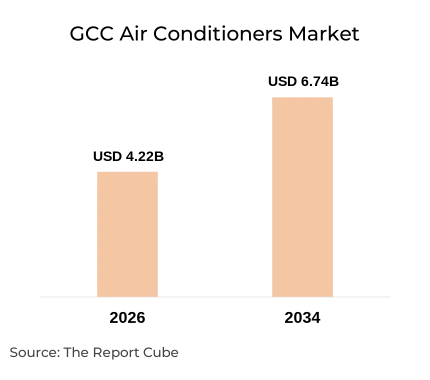
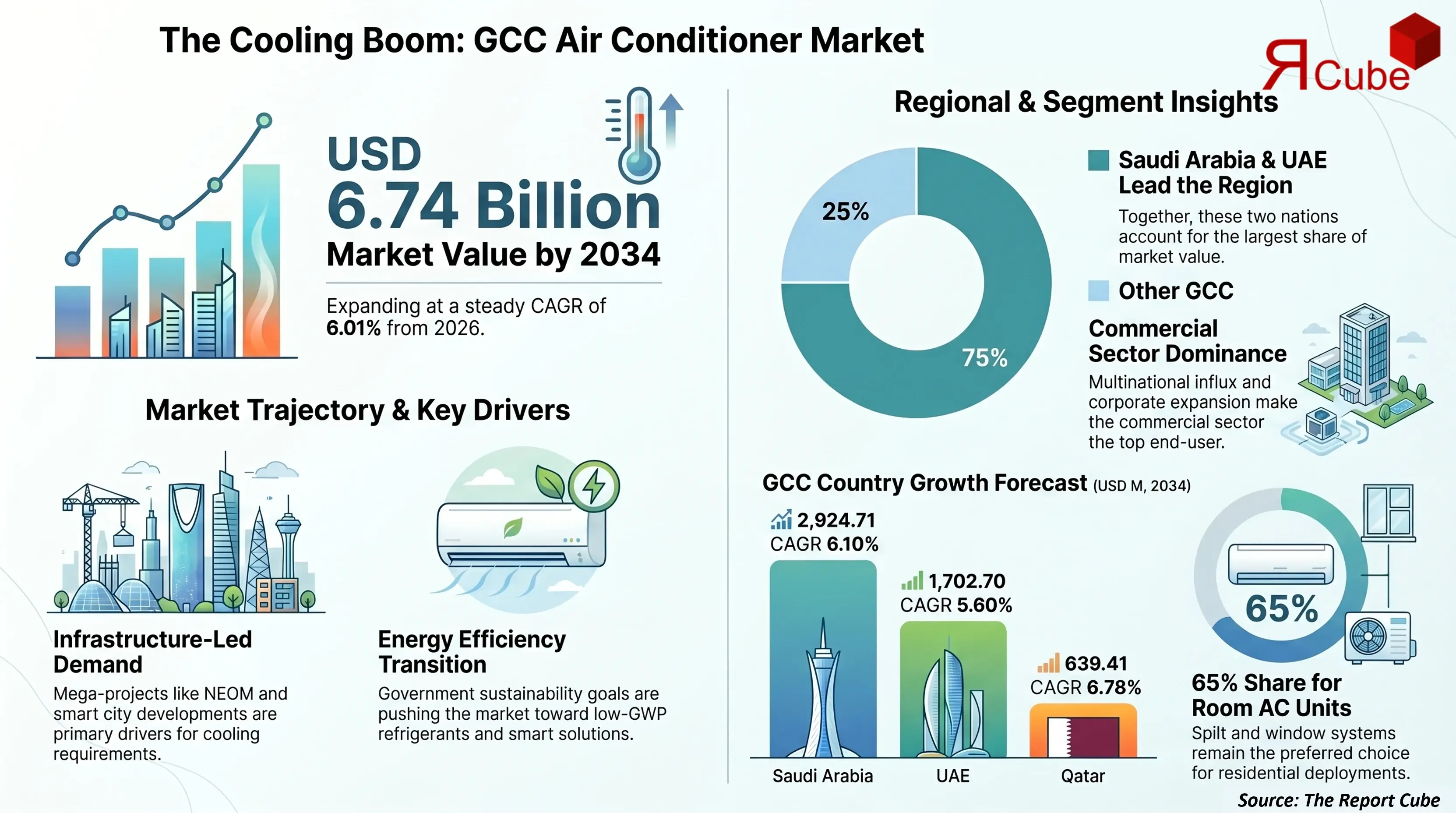
The GCC Air Conditioner Market is estimated to be valued at USD 4.22 Billion in 2026 and is anticipated to register a CAGR of around 6.01% during the forecast period, i.e., 2026-34. Furniture improves people's lives by offering convenience, productivity, and a sense of security in both homes and workplaces. Additionally, furniture's aesthetic appeal has grown in popularity, driving up demand for contemporary and distinctive pieces including desks, beds, cabinets, tables, and chairs. To make these pieces, the furniture business uses a variety of materials, such as metal, wood, plastic, and more.
Several variables are driving the present demand in the Gulf countries' market. Some factors driving the industry's expansion include increasing consumer appetite for residential real estate, real estate development, and government programs to construct socioeconomic infrastructure. Since most furniture in the GCC is imported, the industry had to deal with a drop in imports from the majority of nations in 2020.
Furthermore, the swift progress in technology, urbanization, the expansion of the housing industry, and improved living standards have all contributed to the development of the GCC Air Conditioner Market by aggregating demand for comfort. Due to the unprecedented demand, the sector has become extremely competitive, with various firms vying for possible market share, which would significantly impact the industry's growth in the years to come.
GCC Air Conditioners Market – Impact Analysis
| Factor | Type | Specific Impact | Magnitude | Strategic Insight |
|---|---|---|---|---|
| High Import Dependency (~$4.1B HVAC imports) | Trade Structure | Majority of AC units are imported, especially split and window systems | High | Market pricing and availability tied to global supply chains (China, Asia) |
| Export Re-Distribution Hubs (UAE, Saudi) | Trade Flow Driver | Countries act as re-export hubs to Middle East & Africa | Medium–High | Demand linked to regional trade, not just domestic consumption |
| District Cooling Infrastructure Expansion | System-Level Driver | Large-scale centralized cooling replaces individual AC units | High | Shifts demand from unit sales → large HVAC contracts |
| Mega-Project Driven Demand (NEOM, Expo, Smart Cities) | Infrastructure Driver | Massive cooling requirements embedded in urban planning | Very High | Demand is pre-allocated via government-led projects |
| Cooling as Base Load Electricity Demand | System Constraint | AC accounts for a major share of electricity consumption | High | Drives shift toward high-efficiency and regulated systems |
| Hospitality & Religious Tourism Load (Hajj, Expo, Events) | Usage Intensity Driver | Extreme peak cooling demand in hotels, mosques, public infrastructure | High | Creates high-capacity, continuous-use HVAC demand |
| Oil-to-Non-Oil Economic Diversification | Macro-Economic Driver | Expansion of logistics, retail, aviation, and commercial hubs | High | Cooling demand tied to economic transformation strategies :contentReference[oaicite:0]{index=0} |
| Rapid Growth in Refrigeration & Cold Chain Logistics | Industrial Driver | Rising need for cooling beyond comfort (food, pharma logistics) | Medium–High | Expands HVAC demand into industrial applications |
| Construction Pipeline-Linked Demand Lock-In | Pipeline Driver | AC demand pre-determined by approved housing & infrastructure projects | High | Demand visibility higher than most global markets :contentReference[oaicite:1]{index=1} |
| Rising Export Growth (+19% HVAC exports YoY) | Trade Momentum | Regional manufacturing (esp. Saudi) scaling output | Medium | Transition from pure import market → partial production hub :contentReference[oaicite:2]{index=2} |
GCC Air Conditioner Market Dynamics
- Improved Living Standards & Increasing Temperature to Upscale the Demand for ACs
The heightened deployment of air conditioners on a massive scale can be attributed to the necessity for cooling in the GCC's hot and humid climate, as well as the boom in residential and commercial construction activities due to the rise in disposable income. The region's expanding hospitality sector is driving up demand for air conditioners in hotels and restaurants to give comfort to their guests.
The rapid development of energy-efficient air conditioning systems aligns with the region's sustainability goals, further propelling the growth of the GCC Air Conditioner Market. Furthermore, the presence of established market players in the region, along with their efforts to offer a variety of air conditioning solutions that cater to customer expectations, is poised to contribute significantly to the expansion of the GCC Air Conditioner Market in the forthcoming years.
- Rising Environmental Concerns to Limit the Market Growth
As the region focuses on sustainability, there is a growing concern about the environmental impact of air conditioning systems, particularly those that use refrigerants with high global warming potential (GWP). Hence, with the emergence of eco-friendly alternatives & transitioning to low-GWP refrigerants, the growth of the GCC Air Conditioner Market is estimated to be restricted. As traditional air conditioner contributes to increased carbon emissions & higher energy bills, the emergence of environmentally friendly alternatives would hinder market growth.
- Growing Preference for Energy-Efficient & Smart Air Conditioning Solutions to Thrive the Market
Manufacturers have enhanced air conditioners significantly in response to rising awareness of excessive carbon emissions brought on by rapid technical breakthroughs. It is well known that these gadgets significantly elevate carbon emissions. The expansion of smart & energy-efficient air conditioners is the most recent trend in this area, and it is being heavily backed by several government programs that favor sustainable solutions. In the United Arab Emirates, for example, Daikin Middle East and Africa FZE hosted an event called "Towards a Sustainable Future" in 2023. The company's most recent cutting-edge energy-efficient and indoor air quality (IAQ) solutions were on display at the event.
The increasing need for air conditioners that offer cutting-edge features such as precise temperature control, monitoring capabilities, and energy efficiency in addition to cleaner air is what's causing this change in the air conditioning sector. This need is especially noticeable in the GCC nations, where energy-efficient air conditioners are becoming increasingly popular and driving the expansion of the GCC Air Conditioner Market.
GCC Air Conditioner Market Segment-wise Analysis
By Type:
- Window AC
- Split AC
- Floor Standing AC
- Cassette AC
- Packaged AC
- Ducted Split AC
- Centralized AC
- FCU/AHU
- Chillers
- VRF
Split & window air conditioners are anticipated to capture the potential share of the GCC Air Conditioner Market during 2025-32. These types of air conditioners are well-suited for smaller spaces within residential buildings, such as apartments, and involve minimal installation and structural modifications.
Moreover, they are preferred over cassette or centralized AC systems for small homes due to their convenience & cost-effectiveness. Additionally, their simplicity of cleaning, repair, and maintenance contributes to their broad popularity in the Gulf nations.
Air Conditioners Market Segment Impact Analysis
| Segment | Sub-Segment | Market Share / Trend | Key Insight | Strategic Impact |
|---|---|---|---|---|
| By Type | Room AC (Split + Window) | ~65% market share globally | Dominates due to residential demand growth | Volume-driven segment; core revenue base |
| Split AC | ~53–71% within total AC market | Preferred due to efficiency & flexibility | Primary growth engine across regions | |
| Window AC | Declining share but stable demand | Driven by price-sensitive markets | Important in emerging economies | |
| VRF / Centralized Systems | ~5–7% CAGR growth | Driven by commercial infrastructure | High-margin segment vs volume products | |
| By End User | Residential | ~54–66% market share | Largest segment globally | Volume-led demand; price-sensitive |
| Commercial | Fastest-growing segment | Driven by offices, retail, data centers | Key revenue driver (higher ticket size) | |
| Industrial | Smaller but niche | Used in manufacturing & process cooling | Stable, project-based demand | |
| By Distribution Channel | Offline / Direct Sales | ~70%+ share | Preferred for high-value purchases | Dealer networks critical for conversion |
| Authorized Distributors | Core B2B channel | Handles large commercial orders | Controls institutional sales | |
| Online | Fastest-growing channel | Driven by urban consumers & e-commerce | Important for price discovery & comparison |
By End Users:
- Residential
- Commercial Buildings
- Retail
- Health Care
- Hospitality
- Government & Transportation
- Oil & Gas
- Others (Religious Institutions, etc.,)
The Commercial sector is poised to hold the dominating share in the GCC Air Conditioner Market from 2026 to 2034. This can be primarily attributed to the increasing influx of multinational companies and startups into the region, driven by favorable government policies aimed at attracting Foreign Direct Investments. This trend has led to the establishment of more corporate spaces and a growing demand for facility management services, consequently driving the sales of air conditioners.
Additionally, various governments in the region are focusing on extensive infrastructural development projects. These initiatives encompass the construction of airports, metro systems, railways, educational institutions, shopping malls, and more. The expansion of such facilities is contributing significantly to the demand for air conditioners within the commercial sector and, in turn, fueling the overall market growth.
Country-wise Projection of the GCC Air Conditioner Industry
The GCC Air Conditioner Market is geographically diversified, covering:
| Country | Unit | Market Size 2026 | Market Size 2034 | CAGR (2026–2034) |
|---|---|---|---|---|
| Saudi Arabia | USD Million | 1,821.21 | 2,924.71 | 6.10% |
| UAE | USD Million | 1,101.10 | 1,702.70 | 5.60% |
| Oman | USD Million | 525.43 | 859.19 | 6.34% |
| Qatar | USD Million | 378.32 | 639.41 | 6.78% |
| Kuwait | USD Million | 302.32 | 473.91 | 5.78% |
| Bahrain | USD Million | 101.11 | 145.67 | 4.67% |
The Saudi Arabia and UAE intends to uphold its leadership in the Air Conditioner Market, capturing the largest share from 2026 to 2034. This can be majorly attributed to the strong government support, which includes favorable policies & initiatives focused on encouraging manufacturers to produce energy-efficient air conditioners equipped with advanced technologies.
Furthermore, the UAE's growing appeal as a hub for multinational companies & startups, coupled with a significant influx of tourists, is pushing the demand for air conditioners in various sectors, such as commercial, corporate, and hospitality. This amplified demand is driving the market's growth across the UAE.
Top Companies in GCC Air Conditioner Market
GCC Air Conditioner Market Companies,
Market Share (2026-2034)
Understand The Key Trends Shaping This Market
Download Free SampleWhat Does Our GCC Air Conditioner Market Research Study Entail?
- The GCC Air Conditioner Market Research Report highlights the forecast growth rate or CAGR by anticipating the market size & share.
- The market analysis puts light upon the primary industry trends, driving aspects, potential opportunities, growth challenges, and other major factors.
- The GCC Air Conditioner Market Research Report entails details about the most critical shifts in market share in the prominent regions.
- Considering the statistics & the developments by the primary market competitors, our report also strives to demonstrate the most sought-after strategies of the key players.
Table of Contents
- Introduction
- Objective of the study
- Product Definition
- Market Segmentation
- Study Variables
- Research Methodology
- Secondary Data Points
- Companies Interviewed
- Primary Data Points
- Break Down of Primary Interviews
- Secondary Data Points
- Executive Summary
- Market Dynamics
- Drivers
- Challenges
- Opportunity Assessment
- Recent Trends and Developments
- Import Export Statistics
- List of Major Dealers and Distributors, By Country
- Oman
- Qatar
- Bahrain
- Kuwait
- UAE
- Saudi Arabia
- Key Factors Influencing Purchase Decision
- Key Strategies Adopted by Vendors/Companies to Boost Sales
- Policy and regulatory Landscape, By Country
- Oman
- Qatar
- Bahrain
- Kuwait
- UAE
- Saudi Arabia
- GCC Air Conditioner Market Overview (2020-2032)
- Market Size, Value (in USD Millions)
- Market Size, Units Sold (in Thousand)
- Market Share, By Type
- Window AC
- Upto 1 Ton
- 1.1 to 2 Ton
- Above 2 Ton
- Split AC
- Upto 1 Ton
- 1.1 to1.5 Ton
- 1.6 to 2 Ton
- Cassette AC
- Packaged AC
- Ducted Split AC
- Centralized AC
- FCU/AHU
- Chillers
- VRF
- Others (Floor Standing/Portable AC, etc.)
- Window AC
- Market Share, By End User
- Residential
- Commercial Buildings
- Retail
- Health Care
- Hospitality
- Government & Transportation
- Oil & Gas
- Others (Religious Institutions, etc.,)
- Market Size, By Country
- UAE
- Qatar
- Bahrain
- Kuwait
- Oman
- Saudi Arabia
- Market Share, By Distribution Channel
- Direct Sales
- Online Sales
- Hypermarket/Supermarket
- Authorized Store
- Market Share, By Company
- Competition Characteristics
- Revenue Shares & Analysis
- UAE Air Conditioner Market Overview (2020-2032)
- Market Size, By Value (in USD Millions)
- Market Size, By Units Sold (in Thousand Units)
- Market Share, By Type
- Market Share, By End User
- Market Share, By Sales Channel
- Pricing Analysis
- Market Share, By Region
- Oman Air Conditioner Market Overview (2020-2032)
- Market Size, By Value (in USD Millions)
- Market Size, By Units Sold (in Thousand Units)
- Market Share, By Type
- Market Share, By End User
- Market Share, By Sales Channel
- Pricing Analysis
- Market Share, By Region
- Kuwait Air Conditioner Market Overview (2020-2032)
- Market Size, By Value (in USD Millions)
- Market Size, By Units Sold (in Thousand Units)
- Market Share, By Type
- Market Share, By End User
- Market Share, By Sales Channel
- Pricing Analysis
- Market Share, By Region
- Bahrain Air Conditioner Market Overview (2020-2032)
- Market Size, By Value (in USD Millions)
- Market Size, By Units Sold (in Thousand Units)
- Market Share, By Type
- Market Share, By End User
- Market Share, By Sales Channel
- Pricing Analysis
- Market Share, By Region
- Qatar Air Conditioner Market Overview (2020-2032)
- Market Size, By Value (in USD Millions)
- Market Size, By Units Sold (in Thousand Units)
- Market Share, By Type
- Market Share, By End User
- Market Share, By Sales Channel
- Pricing Analysis
- Market Share, By Region
- Saudi Arabia Air Conditioner Market Overview (2020-2032)
- Market Size, By Value (in USD Millions)
- Market Size, By Units Sold (in Thousand Units)
- Market Share, By Type
- Market Share, By End User
- Market Share, By Sales Channel
- Pricing Analysis
- Market Share, By Region
- Competitive Outlook (Company Profiles – Partial List)
- LG Electronics
- Company Overview
- Business Segments
- Strategic Alliance/Partnerships
- Recent Developments
- Financials
- S.K.M. Air Conditioning
- Company Overview
- Business Segments
- Strategic Alliance/Partnerships
- Recent Developments
- Financials
- Gree Electric Appliances, Inc.
- Company Overview
- Business Segments
- Strategic Alliance/Partnerships
- Recent Developments
- Financials
- Carrier GCC Corporation
- Company Overview
- Business Segments
- Strategic Alliance/Partnerships
- Recent Developments
- Financials
- Daikin Industries, Ltd.
- Company Overview
- Business Segments
- Strategic Alliance/Partnerships
- Recent Developments
- Financials
- Mitsubishi Electric Corporation
- Company Overview
- Business Segments
- Strategic Alliance/Partnerships
- Recent Developments
- Financials
- Trane Technologies Company, LLC.
- Company Overview
- Business Segments
- Strategic Alliance/Partnerships
- Recent Developments
- Financials
- Zamil Air Conditioners Holding Co. Ltd.
- Company Overview
- Business Segments
- Strategic Alliance/Partnerships
- Recent Developments
- Financials
- Toshiba Gulf Fze
- Company Overview
- Business Segments
- Strategic Alliance/Partnerships
- Recent Developments
- Financials
- Others (Panasonic Marketing Middle East & Africa FZE, Samsung Gulf Electronics, Lennox EMEA, Haier Electronics)
- LG Electronics
- Contact Us & Disclaimer
List of Figure
Figure 1: Study framework and research scope
Figure 2: Study objectives and key research questions
Figure 3: Product definition — GCC air conditioner categories and specifications
Figure 4: Market segmentation structure for the GCC air conditioner market
Figure 5: Study variables and measurement metrics
Figure 6: Research methodology and data validation flow
Figure 7: Secondary data points and reference sources
Figure 8: Companies interviewed — coverage by segment
Figure 9: Primary data points captured
Figure 10: Breakdown of primary interviews by respondent type
Figure 11: Executive summary — key market indicators (2020–2032)
Figure 12: Market dynamics — drivers, restraints and growth enablers
Figure 13: Key market drivers influencing AC demand in GCC
Figure 14: Market challenges and risk factors
Figure 15: Opportunity assessment framework
Figure 16: Recent trends and technology developments in GCC AC market
Figure 17: Import–export statistics — GCC air conditioner flows
Figure 18: Major dealers & distributors in Oman
Figure 19: Major dealers & distributors in Qatar
Figure 20: Major dealers & distributors in Bahrain
Figure 21: Major dealers & distributors in Kuwait
Figure 22: Major dealers & distributors in UAE
Figure 23: Major dealers & distributors in Saudi Arabia
Figure 24: Key factors influencing purchase decisions — consumer vs commercial
Figure 25: Key strategies adopted by vendors to boost AC sales
Figure 26: Policy & regulatory landscape — Oman
Figure 27: Policy & regulatory landscape — Qatar
Figure 28: Policy & regulatory landscape — Bahrain
Figure 29: Policy & regulatory landscape — Kuwait
Figure 30: Policy & regulatory landscape — UAE
Figure 31: Policy & regulatory landscape — Saudi Arabia
Figure 32: GCC air conditioner market overview (2020–2032) — value and units sold
Figure 33: GCC market size, by value (USD millions)
Figure 34: GCC market size, by volume (thousand units)
Figure 35: Market share, by AC type — window, split, cassette, packaged, ducted split, centralized, FCU/AHU, chillers, VRF, others
Figure 36: Window AC segment breakdown — <1 ton, 1.1–2 ton, >2 ton
Figure 37: Split AC segment breakdown — <1 ton, 1.1–1.5 ton, 1.6–2 ton
Figure 38: Market share, by end user — residential, commercial buildings, retail, healthcare, hospitality, government & transportation, oil & gas, others
Figure 39: Market size, by GCC country — UAE, Qatar, Bahrain, Kuwait, Oman, Saudi Arabia
Figure 40: Market share, by distribution channel — direct, online, hypermarket/supermarket, authorized store
Figure 41: Market share, by company — major AC manufacturers
Figure 42: Competition characteristics — GCC HVAC landscape
Figure 43: Revenue shares & analysis — top market players
Figure 44: UAE AC market overview — value and units sold
Figure 45: UAE market share, by type
Figure 46: UAE market share, by end user
Figure 47: UAE market share, by sales channel
Figure 48: UAE pricing analysis — category-level comparison
Figure 49: UAE market share, by region
Figure 50: Oman AC market overview — value and units sold
Figure 51: Oman market share, by type
Figure 52: Oman market share, by end user
Figure 53: Oman market share, by sales channel
Figure 54: Oman pricing analysis
Figure 55: Oman market share, by region
Figure 56: Kuwait AC market overview — value and units sold
Figure 57: Kuwait market share, by type
Figure 58: Kuwait market share, by end user
Figure 59: Kuwait market share, by sales channel
Figure 60: Kuwait pricing analysis
Figure 61: Kuwait market share, by region
Figure 62: Bahrain AC market overview — value and units sold
Figure 63: Bahrain market share, by type
Figure 64: Bahrain market share, by end user
Figure 65: Bahrain market share, by sales channel
Figure 66: Bahrain pricing analysis
Figure 67: Bahrain market share, by region
Figure 68: Qatar AC market overview — value and units sold
Figure 69: Qatar market share, by type
Figure 70: Qatar market share, by end user
Figure 71: Qatar market share, by sales channel
Figure 72: Qatar pricing analysis
Figure 73: Qatar market share, by region
Figure 74: Saudi Arabia AC market overview — value and units sold
Figure 75: Saudi Arabia market share, by type
Figure 76: Saudi Arabia market share, by end user
Figure 77: Saudi Arabia market share, by sales channel
Figure 78: Saudi Arabia pricing analysis
Figure 79: Saudi Arabia market share, by region
Figure 80: Company profile snapshot — LG Electronics
Figure 81: Company profile snapshot — S.K.M. Air Conditioning
Figure 82: Company profile snapshot — Gree Electric Appliances
Figure 83: Company profile snapshot — Carrier GCC
Figure 84: Company profile snapshot — Daikin Industries
Figure 85: Company profile snapshot — Mitsubishi Electric Corporation
Figure 86: Company profile snapshot — Trane Technologies
Figure 87: Company profile snapshot — Zamil Air Conditioners
Figure 88: Company profile snapshot — Toshiba Gulf FZE
Figure 89: Company profile snapshot — Panasonic Marketing MEA
Figure 90: Company profile snapshot — Samsung Gulf Electronics
Figure 91: Company profile snapshot — Lennox EMEA
Figure 92: Company profile snapshot — Haier Electronics
List of Table
Table 1: Study objectives and definitions
Table 2: Product definition and AC classification (GCC market)
Table 3: Market segmentation taxonomy and definitions
Table 4: Study variables and measurement units
Table 5: Research methodology — sampling, primary and secondary sources
Table 6: Secondary data sources and reference list
Table 7: Companies interviewed — respondent list and profiles
Table 8: Primary data points and KPIs
Table 9: Breakdown of primary interviews — by respondent type and geography
Table 10: Executive summary — key indicators (2020, 2024, 2032)
Table 11: Market dynamics — drivers, restraints and opportunities
Table 12: Import–export statistics — GCC AC units and values
Table 13: Major dealers & distributors — Oman
Table 14: Major dealers & distributors — Qatar
Table 15: Major dealers & distributors — Bahrain
Table 16: Major dealers & distributors — Kuwait
Table 17: Major dealers & distributors — UAE
Table 18: Major dealers & distributors — Saudi Arabia
Table 19: Key purchase decision factors — consumer vs institutional comparison
Table 20: Vendor strategies — sales, branding and distribution initiatives
Table 21: Policy and regulatory landscape — Oman
Table 22: Policy and regulatory landscape — Qatar
Table 23: Policy and regulatory landscape — Bahrain
Table 24: Policy and regulatory landscape — Kuwait
Table 25: Policy and regulatory landscape — UAE
Table 26: Policy and regulatory landscape — Saudi Arabia
Table 27: GCC market size (value and volume) — historical and forecast
Table 28: Market share, by AC type — value and volume
Table 29: Window AC breakdown — tonnage split
Table 30: Split AC breakdown — tonnage split
Table 31: Market share, by end user — residential, commercial, industrial, government, others
Table 32: Market size, by country — UAE, Qatar, Bahrain, Kuwait, Oman, Saudi Arabia
Table 33: Market share, by distribution channel — direct, online, modern retail, authorized stores
Table 34: Market share, by company — revenue and volume comparison
Table 35: UAE market — size, segment breakdown and pricing
Table 36: Oman market — size, segment breakdown and pricing
Table 37: Kuwait market — size, segment breakdown and pricing
Table 38: Bahrain market — size, segment breakdown and pricing
Table 39: Qatar market — size, segment breakdown and pricing
Table 40: Saudi Arabia market — size, segment breakdown and pricing
Table 41: Competitive landscape — company comparison table
Table 42: Company profiles summary — business segments, alliances, recent developments, financials
Table 43: Revenue shares & analysis — leading GCC AC manufacturers
Table 44: Strategic alliances & partnerships table
Table 45: SWOT summary table for major players
Table 46: Forecasting assumptions and methodology
Table 47: Glossary and abbreviations
Table 48: Contact information and disclaimer
Top Key Players & Market Share Outlook
- LG Electronics
- S.K.M. Air Conditioning
- Gree Electric Appliances, Inc.
- Carrier GCC Corporation
- Daikin Industries, Ltd.
- Mitsubishi Electric Corporation
- Trane Technologies Company, LLC.
- Johnson Controls International Plc.
- Zamil Air Conditioners Holding Co. Ltd.
- Toshiba Gulf Fze
- Panasonic Marketing Middle East & Africa FZE
- Samsung Gulf Electronics
- Lennox EMEA
- Haier Electronics
- Fujitsu General (Middle East) FZE
- others
Frequently Asked Questions






