



Build Your Custom Market Intelligence Report
Customize Your ReportJapan Pacemakers Market Key Highlights
By Type:
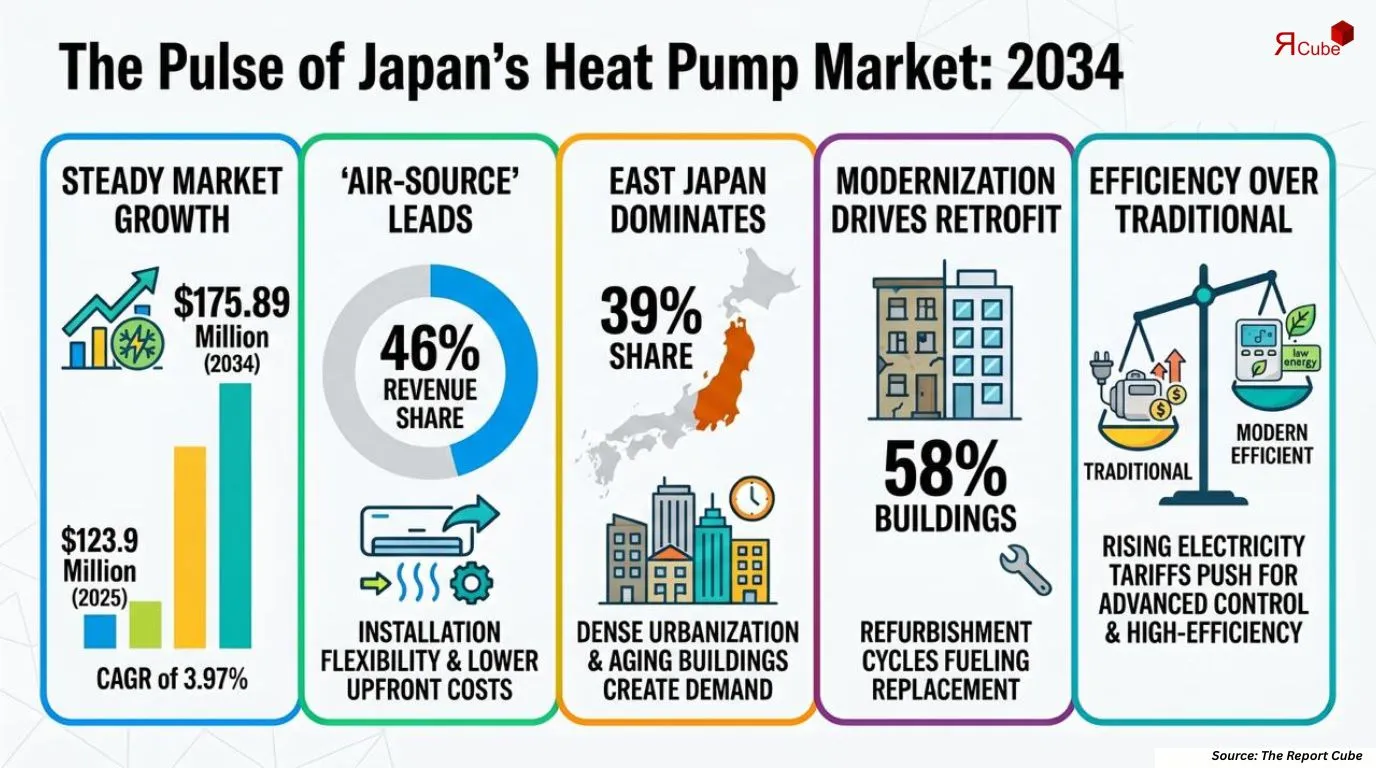
Air-source segment leads the market, accounting for nearly 46% of total revenue.
By End-User:
Residential segment dominates the market, representing around 52% share.
Regional Outlook:
East Japan region holds the leading position with approximately 39% market share.
Government Initiatives & Policies
- Japan METI Energy Conservation Program: Promotes adoption of high-efficiency systems through subsidies and performance standards.
- Green Growth Strategy of Japan: Supports low-carbon heating and cooling technologies across residential and commercial sectors.
Japan Pacemakers Market Insights & Analysis
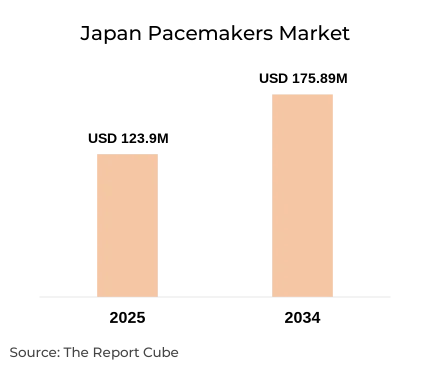
The Japan Pacemakers Market is anticipated to register a CAGR of 3.97% during 2026-2034. The market size was valued at USD 123.9 million in 2025 and is projected to reach USD 175.89 million by 2034. Market growth is supported by Japan’s steady demand for energy-efficient heating and cooling solutions, combined with replacement-driven installations in aging residential and commercial buildings.
Japan’s built environment is undergoing gradual modernization, with over 58% of residential buildings constructed before 1990 now entering refurbishment cycles. This structural aging creates consistent demand for retrofit and replacement installations. Rising electricity prices and carbon reduction targets are further influencing purchasing decisions, pushing end users toward systems that deliver long-term operational savings. Manufacturers are responding with compact, high-performance solutions tailored for limited indoor and outdoor space availability, a critical requirement in dense urban regions. Investment activity remains stable, with domestic players focusing on incremental efficiency gains rather than disruptive technology shifts, aligning with Japan’s preference for reliability and lifecycle performance.
Japan Pacemakers Market Dynamics
Key Driver: Growing Focus on Energy Efficiency and Building Modernization
Energy efficiency has become a central driver shaping the Japan pacemakers market. National energy consumption data shows that space heating, cooling, and water heating account for nearly 36% of household energy use. As electricity tariffs rise and carbon reduction commitments tighten, consumers are prioritizing systems that deliver consistent performance with lower energy input. Pacemaker systems with advanced control mechanisms and improved heat exchange efficiency are increasingly selected during renovation projects. Commercial property owners are also upgrading older installations to comply with revised building efficiency guidelines, contributing to stable demand. This focus on modernization ensures predictable market expansion rather than short-term demand spikes.
Book your FREE 30-minute expert consultation today
Contact UsIndustry Trends: Increasing Preference for Air-Source and Hybrid Configurations
Market trends indicate a gradual shift toward air-source and hybrid-source configurations. Air-source systems are favored for their lower upfront cost, simplified installation, and adaptability to Japan’s varied climatic zones. Hybrid systems are gaining attention in commercial applications where performance stability is required across seasonal temperature fluctuations. Manufacturers are investing in inverter-driven compressors and smart control interfaces that optimize output based on ambient conditions. Sales data from 2024 suggests that air-source variants recorded year-on-year unit growth of approximately 6%, outpacing ground-source alternatives. This trend reflects practical adoption preferences rather than experimental deployment.
Major Challenge: High Installation Costs for Large-Capacity Systems
Installation costs remain a notable barrier, particularly for systems above 50 kW capacity. Commercial and industrial users face additional expenses related to structural modifications, electrical upgrades, and skilled labor requirements. Ground-source installations require drilling and land preparation, increasing project timelines and budgets. These cost factors limit adoption among small enterprises and older commercial buildings with structural constraints. While long-term energy savings are well recognized, the initial capital requirement continues to influence purchasing decisions, slowing penetration in certain end-user categories.
Opportunity: Expansion of Retrofit and Replacement Installations
Replacement and retrofit projects present a significant opportunity for market participants. More than 60% of existing heating and cooling systems in Japan are over 15 years old, approaching the end of their efficient operating life. Consumers increasingly favor upgrading to modern pacemaker systems rather than repairing outdated equipment. Government incentives tied to energy performance improvements further strengthen this opportunity. Manufacturers offering modular designs and simplified installation processes are well positioned to capture this replacement-driven demand, particularly in residential and small commercial segments.
Japan Pacemakers Market Segment-wise Analysis
By Type:
- Water-Source
- Hybrid-Source
- Ground-Source
- Air-Source
Air-source pacemakers dominate the Japan pacemakers market, holding approximately 46% share in 2025. Their leadership is driven by installation flexibility, lower upfront costs, and compatibility with retrofit projects. Urban residential buildings, which account for a large share of housing stock, favor air-source systems due to space limitations. Technological improvements in cold-climate performance have also enhanced adoption in northern regions. As manufacturers continue refining efficiency and noise reduction, this segment is expected to maintain its leading position throughout the forecast period.
By Rated Capacity:
- Up to 10 kW
- 10-25 kW
- 25-50 kW
- 50-100 kW
- Above 100 kW
The 10-25 kW capacity segment accounts for nearly 34% of market revenue, primarily driven by residential and small commercial applications. This capacity range offers an optimal balance between output and energy consumption, making it suitable for multi-family housing and small office buildings. Replacement demand within this segment remains strong, supported by standardized installation requirements and broad product availability.
Regional Projection of Japan Pacemakers Industry
- East
- South
- North
- West
East Japan leads the pacemakers market with approximately 39% share, supported by dense urbanization, higher construction activity, and a larger concentration of aging buildings requiring system upgrades. The region benefits from well-established distribution networks and higher consumer awareness of energy-efficient technologies. West Japan follows with steady growth, driven by commercial installations and tourism-related infrastructure. Northern regions show gradual adoption supported by cold-climate performance improvements, while southern regions benefit from demand for efficient cooling solutions.
Japan Pacemakers Market Recent Developments
- 2025: Medtronic announced that four of its technologies received Japan’s Good Design Award. This recognition highlighted the company’s strength in design and innovation within the Japanese medical device market, including advanced cardiac and rhythm management solutions relevant to pacemaker therapy.
- 2025: MicroPort CRM reported the first Japanese implantation in the PIANO international post-market study sub-study. The procedure used the GALI SonR CRT-D at Chiba University Hospital and aims to generate real-world data aligned with MDR requirements while improving outcomes for patients with heart failure.
- 2025: Japan Lifeline investor document noted Abbott’s development of a new type of leadless pacemaker. This development reflects increasing collaboration and technology inflow into the Japanese market and underscores continued innovation in miniaturized, less invasive pacing solutions.
Need insights for a specific region within this market?
Request Regional DataWhy Choose This Report?
- Provides a comprehensive overview of the overall market analysis, encompassing key trends, consumer behavior analysis, and risk assessment to support strategic decision-making.
- Provides accurate, up-to-date insights into market size, segmentation, and emerging opportunities, helping to minimize risk & capitalizing on growth.
- Gives deep understanding of target audience preferences, investment habits, and communication channels for enhanced product development & marketing effectiveness.
- Delivers competitive analysis & benchmarking, uncovering the strengths & weaknesses of market competitors to guide strategies.
- Consolidate comprehensive market intelligence, reducing reasoning & streamlining research efforts.
- Facilitates customized market segmentation & risk mitigation strategies, fine-tuned to the business objectives.
- Aids in identifying both market challenges & untapped opportunities within the industry to drive long-term business growth.
- Provides valuable information based on actual customer data & search trends.
Table of Contents
- Introduction
- Objective of the Study
- Product and Category Definition
- Market Segmentation
- Study Variables
- Research Methodology
- Secondary Data Points
- Breakdown of Secondary Sources
- Primary Data Points
- Breakdown of Primary Interviews
- Secondary Data Points
- Executive Summary
- Market Dynamics
- Drivers
- Challenges
- Opportunity Assessment
- Recent Trends and Developments
- Regulatory and Policy Landscape
- Japan Pacemakers Market Overview (2021-2034)
- Market Size, By Value (USD Billion/Million
- Market Size, By Volume (Units)
- Market Share, By Product Type
- External Pacemakers
- Implantable Pacemakers
- Market Share, By Technology
- Single-Chamber Pacemakers
- Dual-Chamber Pacemakers
- Biventricular Pacemakers
- Market Share, By Device Platform
- Leadless Pacemakers
- Conventional Transvenous Pacemakers
- MRI-Compatible Pacemakers
- Market Share, By Component
- Leads
- Accessories & Programming Systems
- Pulse Generator
- Market Share, By Clinical Indication
- Post-Myocardial Infarction Temporary Pacing
- Bradyarrhythmias
- Sick Sinus Syndrome
- Heart Block
- Heart Failure (CRT Indication)
- Atrial Fibrillation with Slow Ventricular Response
- Others
- Market Share, By End User
- Ambulatory Surgical Centers
- Hospitals & Cardiac Centers
- Others
- Market Share, By Region
- Chubu
- Hokkaido
- Kanto
- Tohoku
- Others
- Market Share, By Company
- Revenue Shares & Analysis
- Competitive Landscape
- Chubu Pacemakers Market
- Market Size, By Value (USD Billion/Million
- Market Size, By Volume (Units)
- Market Share, By Product Type
- Market Share, By Technology
- Market Share, By Device Platform
- Market Share, By Component
- Market Share, By Clinical Indication
- Market Share, By End User
- Hokkaido Pacemakers Market
- Market Size, By Value (USD Billion/Million
- Market Size, By Volume (Units)
- Market Share, By Product Type
- Market Share, By Technology
- Market Share, By Device Platform
- Market Share, By Component
- Market Share, By Clinical Indication
- Market Share, By End User
- Kanto Pacemakers Market
- Market Size, By Value (USD Billion/Million
- Market Size, By Volume (Units)
- Market Share, By Product Type
- Market Share, By Technology
- Market Share, By Device Platform
- Market Share, By Component
- Market Share, By Clinical Indication
- Market Share, By End User
- Tohoku Pacemakers Market
- Market Size, By Value (USD Billion/Million
- Market Size, By Volume (Units)
- Market Share, By Product Type
- Market Share, By Technology
- Market Share, By Device Platform
- Market Share, By Component
- Market Share, By Clinical Indication
- Market Share, By End User
- Competitive Outlook and Company Profiles
- MicroPort Scientific Corporation
- Company Overview
- Product Portfolio
- Strategic Alliances/Partnerships
- Recent Developments
- ZOLL Medical Corporation
- Company Overview
- Product Portfolio
- Strategic Alliances/Partnerships
- Recent Developments
- Osypka Medical GmbH
- Company Overview
- Product Portfolio
- Strategic Alliances/Partnerships
- Recent Developments
- Abbott Laboratories
- Company Overview
- Product Portfolio
- Strategic Alliances/Partnerships
- Recent Developments
- Medtronic Plc
- Company Overview
- Product Portfolio
- Strategic Alliances/Partnerships
- Recent Developments
- BIOTRONIK SE & Co. KG
- Company Overview
- Product Portfolio
- Strategic Alliances/Partnerships
- Recent Developments
- Boston Scientific Corporation
- Company Overview
- Product Portfolio
- Strategic Alliances/Partnerships
- Recent Developments
- Japan Lifeline Co., Ltd.
- Company Overview
- Product Portfolio
- Strategic Alliances/Partnerships
- Recent Developments
- Others
- MicroPort Scientific Corporation
- Contact Us and Disclaimer
Top Key Players & Market Share Outlook
- MicroPort Scientific Corporation
- ZOLL Medical Corporation
- Osypka Medical GmbH
- Abbott Laboratories
- Medtronic Plc
- BIOTRONIK SE & Co. KG
- Boston Scientific Corporation
- Japan Lifeline Co., Ltd.
- Others
Frequently Asked Questions






