



Build Your Custom Market Intelligence Report
Customize Your ReportBelgium Beer Market Insights & Analysis
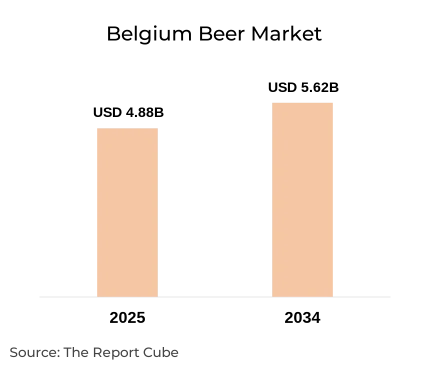
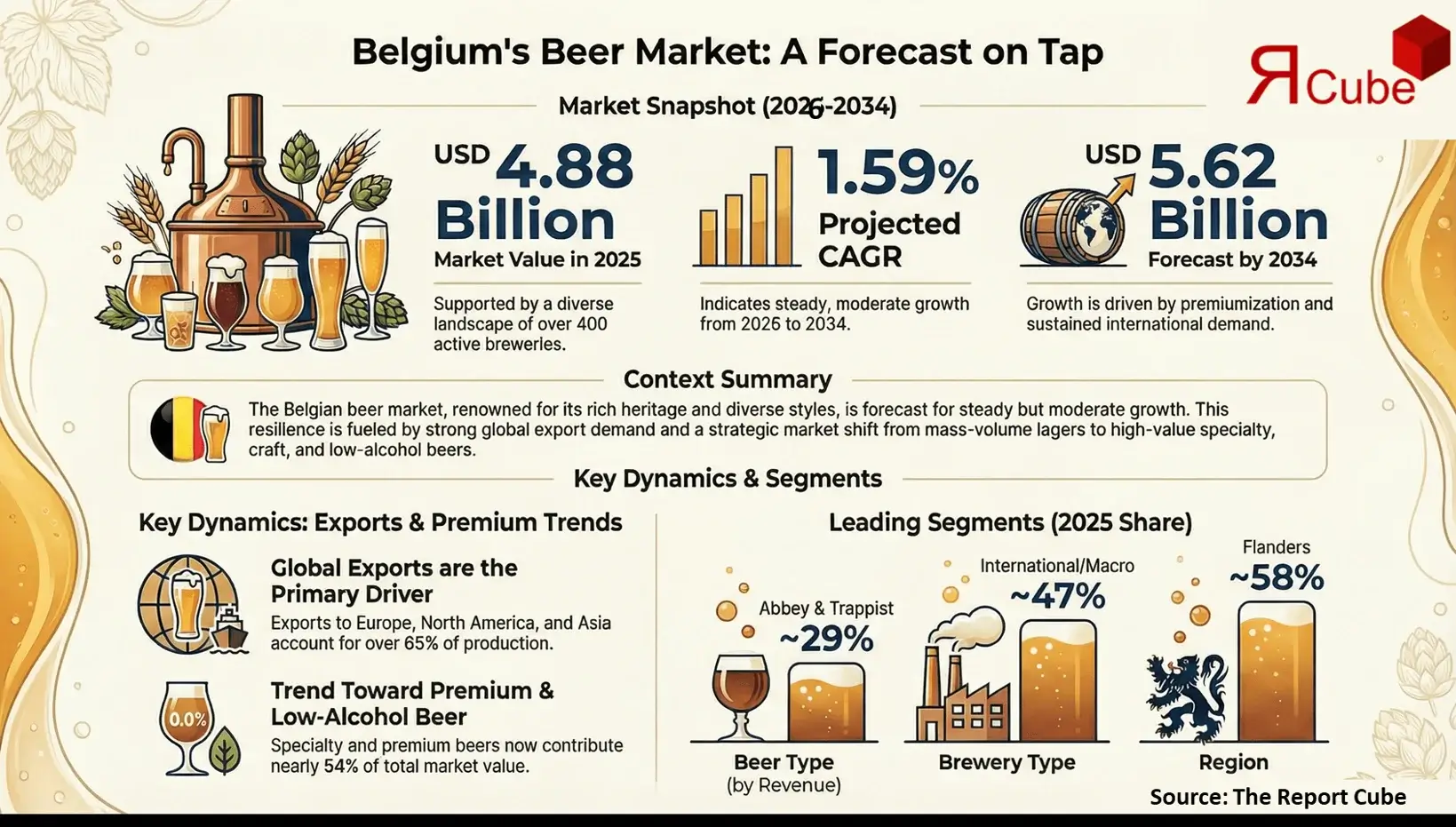
The Belgium Beer Market is anticipated to register a CAGR of 1.59% during 2026-2034. The market size was valued at USD 4.88 Billion in 2025 and is projected to reach USD 5.62 Billion by 2034. the market holds a unique and globally recognized position, deeply rooted in centuries-old brewing traditions, diverse beer styles, and strong cultural identity. Belgium is widely regarded as one of the world’s most influential beer-producing nations, with a reputation built on specialty beers such as Trappist, Abbey, lambic, and sour varieties. In 2025, Belgium maintained over 400 active breweries, ranging from large international producers to small monastic and craft brewers, reflecting a highly diversified production landscape. Domestic consumption remains stable despite broader European declines in beer volumes, supported by strong cultural attachment, premium positioning, and export-oriented production. Belgian beer exports account for more than 65% of total production, reinforcing the country’s importance as a global beer supplier. This balance between domestic tradition and international demand underpins the market’s resilience.
Market dynamics are increasingly shaped by premiumization, tourism-driven consumption, and evolving consumer preferences toward quality over quantity. While overall per capita beer consumption has moderated, value growth is sustained through higher-priced specialty beers, limited editions, and artisanal offerings. In 2025, specialty and premium beers contributed nearly 54% of total market value, highlighting Belgium’s shift away from mass-volume lagers toward differentiated products. Additionally, rising interest in non- and low-alcohol beer variants is reshaping portfolios, particularly among younger consumers and health-conscious drinkers. Strong on-trade recovery through cafés, beer halls, and tourism hubs further supports demand. These factors collectively ensure steady, moderate growth across the forecast period.
Belgium Beer Market Recent Developments
- 2025: Duvel Moortgat expanded specialty and low-alcohol beer offerings for domestic and export markets.
- 2025: AB InBev Belgium increased investment in premium and sustainable brewing operations.
Government Initiatives & Policies
- Belgian Brewers Sustainability Charter: Industry-backed initiative promoting responsible production, energy efficiency, and water management.
- EU Alcohol Strategy & Labeling Regulations: Framework influencing transparency, consumer information, and responsible consumption.
Belgium Beer Market Dynamics
Key Driver: Strong Brewing Heritage and Global Export Demand
The primary driver of the Belgium beer market is its globally respected brewing heritage combined with sustained international demand. Belgian beer styles are protected by tradition, quality standards, and authenticity, making them highly sought after in export markets. In 2025, exports to Western Europe, North America, and Asia accounted for a majority of production value. Domestically, cultural appreciation for beer remains strong, with beer deeply integrated into social, culinary, and tourism experiences. This dual reliance on heritage-driven domestic consumption and premium exports ensures stable revenue streams for both large and small brewers, supporting long-term market continuity.
Major Challenge: Declining Volume Consumption and Regulatory Pressure
A key challenge facing the Belgium beer market is declining volume consumption driven by changing lifestyles, health awareness, and stricter alcohol regulations. Younger consumers are drinking less alcohol overall, while regulations related to advertising, labeling, and public consumption increase compliance costs. Additionally, rising input costs for energy, raw materials, and packaging pressure margins, particularly for smaller breweries. Managing profitability while maintaining traditional brewing methods and quality standards requires careful cost control and strategic pricing across the industry.
Industry Trends: Premiumization and Low-Alcohol Innovation
An important industry trend is the continued premiumization of beer offerings alongside rapid innovation in low- and non-alcohol beer categories. Belgian brewers are leveraging their expertise to create flavorful low-alcohol alternatives without compromising taste or authenticity. In 2025, non- and low-alcohol beers accounted for approximately 9% of domestic beer sales value, a share that is steadily increasing. At the same time, consumers are gravitating toward specialty ales, sour beers, and barrel-aged varieties, reinforcing Belgium’s reputation for complexity and craftsmanship.
Opportunity Ahead: Beer Tourism and Craft Export Expansion
Future opportunities lie in beer tourism and expanding craft beer exports. Brewery tours, beer festivals, and gastronomic tourism attract millions of visitors annually, driving on-trade sales and brand engagement. Additionally, smaller craft and Trappist breweries are gaining international recognition, opening export opportunities in premium markets. Brewers that invest in storytelling, authenticity, and controlled capacity expansion can capitalize on global demand while preserving brand heritage.
Belgium Beer Market Segment-wise Analysis
By Beer Type:
- Lager
- Ale
- Abbey & Trappist
- Wheat Beer
- Lambic & Sour
- Stout & Porter
- Non/Low-Alcohol Beer
- Others
Abbey and Trappist beers represent the leading value segment, accounting for approximately 29% of total market revenue in 2025 due to premium pricing, limited production, and strong export demand. Lagers continue to dominate volume consumption, while lambic and sour beers maintain a strong niche following. Non- and low-alcohol beers are the fastest-growing category, driven by health-conscious consumers.
By Brewery Type:
- International/Macro Breweries
- Regional & Local Breweries
- Craft & Microbreweries
International and macro breweries lead the market with nearly 47% share in 2025, supported by strong distribution networks and export capacity. However, craft and microbreweries contribute significantly to value growth, innovation, and brand differentiation. Regional and local breweries maintain stable demand through heritage brands and local loyalty.
Regional Projection of Belgium Beer Industry
- Flanders
- Wallonia
- Brussels-Capital Region
Flanders leads the Belgium beer market with approximately 58% share in 2025, driven by higher population density, concentration of major breweries, and strong export logistics. Wallonia follows, supported by Trappist and regional specialty breweries. The Brussels-Capital Region, while smaller in volume, contributes disproportionately through on-trade consumption, tourism, and premium beer demand.
Why Choose This Report?
- Provides a comprehensive overview of the overall market analysis, encompassing key trends, consumer behavior analysis, and risk assessment to support strategic decision-making.
- Provides accurate, up-to-date insights into market size, segmentation, and emerging opportunities, helping to minimize risk & capitalizing on growth.
- Gives deep understanding of target audience preferences, investment habits, and communication channels for enhanced product development & marketing effectiveness.
- Delivers competitive analysis & benchmarking, uncovering the strengths & weaknesses of market competitors to guide strategies.
- Consolidate comprehensive market intelligence, reducing reasoning & streamlining research efforts.
- Facilitates customized market segmentation & risk mitigation strategies, fine-tuned to the business objectives.
- Aids in identifying both market challenges & untapped opportunities within the industry to drive long-term business growth.
- Provides valuable information based on actual customer data & search trends.
Table of Contents
- Introduction
- Objective of the Study
- Product/Category Definition
- Market Segmentation
- Study Variables
- Research Methodology
- Secondary Data Points
- Breakdown of Secondary Sources
- Primary Data Points
- Breakdown of Primary Interviews
- Secondary Data Points
- Executive Summary
- Market Dynamics
- Drivers
- Challenges
- Opportunity Assessment
- Recent Trends and Developments
- Policy and Regulatory Landscape
- Belgium Beer Market Overview (2020-2034)
- Market Size, By Volume (Million Hectoliters) & Value (EUR Million)
- Market Share, By Beer Type
- Lager
- Ale
- Abbey & Trappist
- Wheat Beer
- Lambic & Sour
- Stout & Porter
- Non/Low-Alcohol Beer
- Others
- Market Share, By Brewery Type
- International/Macro Breweries
- Regional & Local Breweries
- Craft & Microbreweries
- Market Share, By Packaging
- Bottles
- Cans
- Kegs & Draught
- Others
- Market Share, By Distribution Channel
- On-Trade
- Off-Trade Supermarkets & Hypermarkets
- Supermarkets Hypermarkets
- Convenience Stores
- Specialty Stores
- Others
- Market Share, By Age Group
- 18-25 years
- 25-40 years
- 40-55 years
- 55+ years
- Market Share, By Alcohol Leve
- Low
- Regular
- High
- Market Share, By Gender
- Male
- Female
- Others
- Market Share, By Flavor
- Unflavored Beer
- Flavored Beer
- Market Share, By Region
- Flanders
- Wallonia
- Brussels-Capital Region
- Market Share, By Company
- Revenue Shares
- Competitive Landscape
- Segment-wise & Category-wise Market Forecast (2026-2034)
- By Beer Type
- By Brewery Type
- By Packaging
- By Distribution Channel
- By Region
- Flanders Beer Market
- Market Size, By Volume & Value (EUR Million)
- Market Share, By Beer Type
- Market Share, By Brewery Type
- Market Share, By Distribution Channel
- Market Share, By Key Cities
- Wallonia Beer Market
- Market Size, By Volume & Value (EUR Million)
- Market Share, By Beer Type
- Market Share, By Brewery Type
- Market Share, By Distribution Channel
- Market Share, By Key Cities
- Brussels-Capital Region Beer Market
- Market Size, By Volume & Value (EUR Million)
- Market Share, By Beer Type
- Market Share, By Brewery Type
- Market Share, By Distribution Channel
- Market Share, By Key Cities
- Competitive Outlook & Company Profiles
- AB InBev
- Company Overview
- Product Portfolio
- Strategic Alliances/Partnerships
- Recent Developments
- Duvel Moortgat
- Company Overview
- Product Portfolio
- Strategic Alliances/Partnerships
- Recent Developments
- Alken-Maes
- Company Overview
- Product Portfolio
- Strategic Alliances/Partnerships
- Recent Developments
- Chimay
- Company Overview
- Product Portfolio
- Strategic Alliances/Partnerships
- Recent Developments
- Westmalle
- Company Overview
- Product Portfolio
- Strategic Alliances/Partnerships
- Recent Developments
- Rodenbach
- Company Overview
- Product Portfolio
- Strategic Alliances/Partnerships
- Recent Developments
- Lindemans
- Company Overview
- Product Portfolio
- Strategic Alliances/Partnerships
- Recent Developments
- La Trappe
- Company Overview
- Product Portfolio
- Strategic Alliances/Partnerships
- Recent Developments
- De Halve Maan
- Company Overview
- Product Portfolio
- Strategic Alliances/Partnerships
- Recent Developments
- Others
- AB InBev
- Contact Us / Disclaimer
Top Key Players & Market Share Outlook
- AB InBev
- Duvel Moortgat
- Alken‑Maes
- Chimay
- Westmalle
- Rodenbach
- Lindemans
- La Trappe
- De Halve Maan
- Others
Frequently Asked Questions






