




Build Your Custom Market Intelligence Report
Customize Your ReportGlobal Free Range Meat Market Insights & Analysis
The Global Free Range Meat Market is anticipated to register a 4.78% CAGR during 2026-2034. The market size was valued at USD 135.03 billion in 2025 and is projected to reach USD 205.56 billion by 2034.
The market is expanding steadily as consumers increasingly prioritize animal welfare, clean-label products, and sustainable livestock practices. Free range meat, produced from animals raised with outdoor access and natural feeding conditions, is gaining traction among health-conscious and ethically driven buyers. More than 54% of global consumers now report willingness to pay a premium for meat products perceived as humane and antibiotic-free. This shift is particularly visible in developed economies, where transparency, traceability, and certification standards influence purchasing decisions.
Retailers and foodservice chains are also reshaping procurement policies to include cage-free and free range sourcing commitments. Quick-service restaurant brands and supermarket chains have publicly pledged to transition toward higher animal welfare standards by 2030, accelerating supplier transformation. Meanwhile, emerging markets are witnessing gradual adoption as disposable income rises and modern retail penetration increases. Growth remains moderate compared to plant-based alternatives, yet free range meat continues to command price premiums ranging between 15–30% over conventional products. With sustainability becoming central to global food supply chains, the industry is poised for resilient expansion through 2034.
Global Free Range Meat Market Recent Developments
- 2025: Tyson Foods expanded its free range poultry portfolio across major U.S. retail chains.
- 2025: Maple Leaf Foods launched carbon-neutral certified free range pork products in Canada.
Government Initiatives & Policies
- EU Farm to Fork Strategy: Promotes sustainable livestock production and animal welfare reforms.
- USDA Organic & Animal Welfare Standards: Strengthens labeling and outdoor access compliance for livestock.
Global Free Range Meat Market Dynamics
Key Driver: Growing Consumer Preference for Ethical and Clean-Label Meat
Consumer awareness regarding food sourcing, antibiotic usage, and livestock welfare is a key growth driver for the Global Free Range Meat Market. Surveys indicate that nearly 60% of urban consumers actively check meat labels for production claims such as “free range,” “grass-fed,” or “antibiotic-free.” This behavioral shift is closely linked to rising health concerns and environmental consciousness. Free range farming practices, which allow animals access to open environments and natural diets, align with evolving perceptions of humane treatment and superior product quality. In North America and Europe, regulatory frameworks increasingly support transparent labeling, reinforcing trust and driving premiumization. Retail shelf space dedicated to specialty meats has expanded by approximately 18% over the past five years. Foodservice operators are also responding by featuring ethically sourced meat options to differentiate menus and enhance brand reputation. As transparency becomes a purchasing priority, demand for certified free range meat products is expected to strengthen steadily through 2034.
Industry Trends: Integration of Sustainability Certifications and Carbon Reduction Goals
Sustainability integration is reshaping production and marketing strategies across the free range meat industry. Companies are increasingly adopting third-party certifications to validate animal welfare and environmental commitments. Carbon-neutral labeling, regenerative agriculture practices, and pasture-rotation techniques are gaining adoption among leading producers. Around 35% of major meat processors have publicly announced greenhouse gas reduction targets aligned with global climate frameworks. Digital traceability solutions using QR codes and blockchain-based tracking are also emerging, enabling consumers to verify farm origin and welfare standards instantly. Retailers report that certified sustainable meat products achieve up to 22% higher repeat purchase rates compared to non-certified alternatives. Additionally, hybrid farming models that combine free range practices with technological monitoring systems are improving feed efficiency and livestock health outcomes. These innovations are helping producers balance cost structures while meeting stricter environmental compliance requirements.
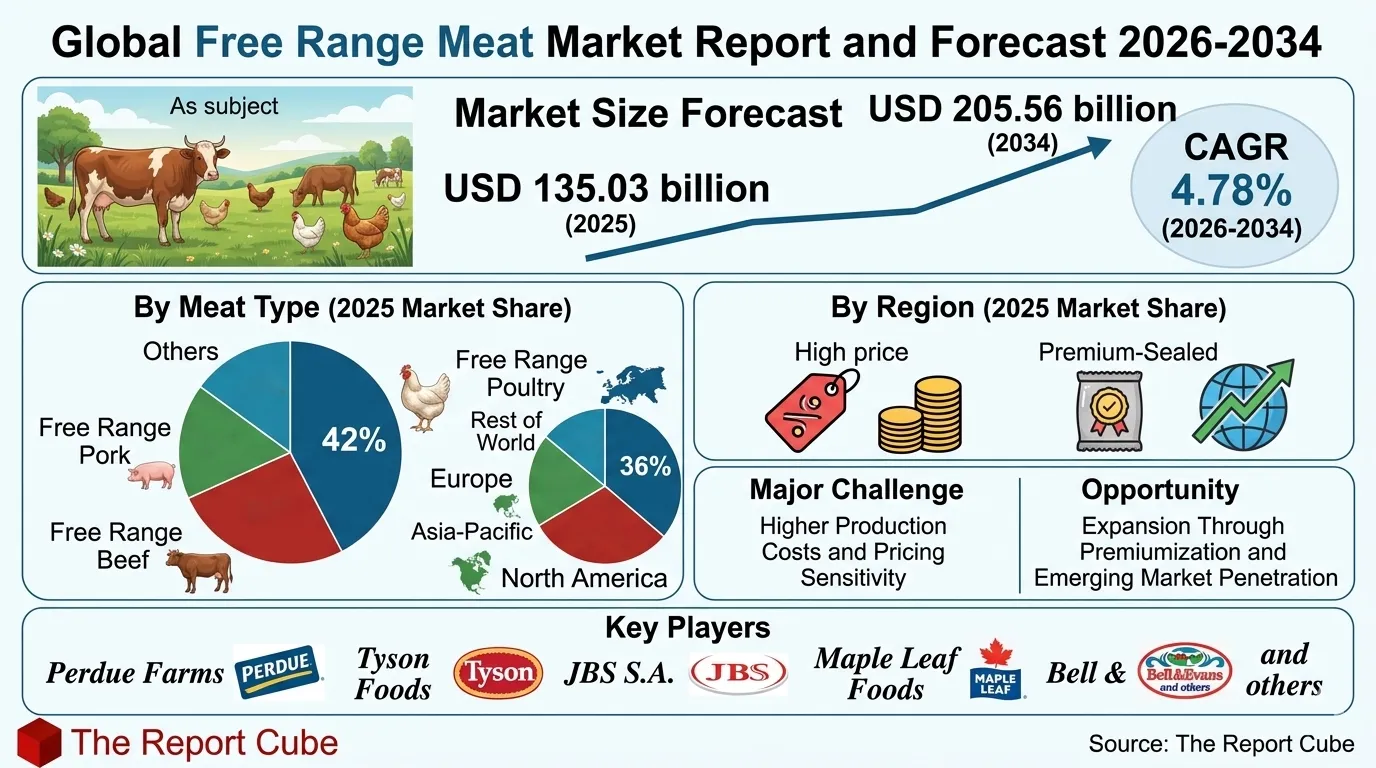
Major Challenge: Higher Production Costs and Pricing Sensitivity
Despite strong ethical appeal, the Global Free Range Meat Market faces cost-related constraints that limit rapid scalability. Free range livestock systems require larger land areas, longer growth cycles, and higher feed expenditures compared to intensive farming models. Production costs can be 20–40% higher, translating into elevated retail prices. While affluent consumers are willing to absorb premiums, price-sensitive segments remain hesitant. Economic slowdowns and inflationary pressures further intensify purchasing trade-offs. In emerging economies, conventional meat continues to dominate due to affordability advantages. Supply chain complexities, including certification audits and compliance documentation, add administrative overheads. Moreover, inconsistent global definitions of “free range” may create confusion and reduce consumer confidence in certain markets. Addressing these challenges will require operational efficiencies, policy support, and strategic price optimization to maintain steady adoption rates.
Opportunity: Expansion Through Premiumization and Emerging Market Penetration
Premiumization presents a significant opportunity for long-term growth. As middle-class populations expand in Asia Pacific and Latin America, consumer spending on quality protein products is rising. Industry estimates suggest that Asia Pacific’s premium meat consumption is increasing at over 6% annually. Producers are leveraging this trend by launching value-added offerings such as marinated cuts, ready-to-cook free range meals, and organic-certified variants. E-commerce channels further enhance accessibility, particularly in urban centers where online grocery penetration exceeds 25%. Partnerships with upscale restaurants and specialty retailers are strengthening brand positioning. Additionally, regenerative farming incentives and government-backed sustainability grants in several regions are encouraging producers to transition toward free range systems. As environmental awareness deepens globally, premium ethically sourced meat is expected to secure a stable consumer base and consistent revenue streams through 2034.
Global Free Range Meat Market Segment-wise Analysis
By Meat Type:
- Free Range Poultry
- Free Range Beef
- Free Range Pork
- Free Range Lamb & Mutton
Free Range Poultry leads the segment, accounting for approximately 42% of the global market share in 2025. Poultry’s shorter production cycle and relatively lower price premium compared to beef contribute to its dominance. Retail chains increasingly prioritize cage-free chicken sourcing, strengthening demand. Free Range Beef follows closely, driven by grass-fed labeling and sustainability claims. Pork and Lamb & Mutton maintain stable shares, particularly in Europe and Oceania, where pasture-based farming traditions are well established. Product innovation within poultry continues to drive category expansion and accessibility.
By Distribution Channel:
- Supermarkets & Hypermarkets
- Specialty Meat Stores
- Online Retail
- Foodservice
Supermarkets & Hypermarkets dominate distribution, contributing nearly 48% of total sales in 2025. Their extensive cold-chain infrastructure and brand partnerships support wide product availability. Specialty meat stores maintain strong positioning among premium consumers seeking traceability assurance. Online retail is emerging rapidly, growing at a CAGR exceeding 8%, driven by convenience and subscription-based meat delivery models. Foodservice demand is rising as restaurants integrate ethically sourced meat to enhance brand credibility. Retail consolidation and omni-channel strategies are expected to further strengthen organized distribution networks globally.
Regional Projection of Global Free Range Meat Industry
- North America
- Europe
- Asia Pacific
- South America
Europe leads the Global Free Range Meat Market, holding approximately 36% market share in 2025. Strong regulatory frameworks supporting animal welfare, high consumer awareness, and established organic farming networks drive regional dominance. Countries such as the UK, Germany, and France exhibit high penetration of certified free range poultry and pork products. North America follows closely, supported by retailer commitments and growing premium meat consumption trends. Asia Pacific is projected to witness the fastest growth through 2034 due to urbanization and income expansion. South America presents export-oriented opportunities, particularly in free range beef production. Regional growth patterns highlight mature markets sustaining revenue stability while emerging economies deliver incremental demand acceleration.
Why Choose This Report?
- Provides a comprehensive overview of the overall market analysis, encompassing key trends, consumer behavior analysis, and risk assessment to support strategic decision-making.
- Provides accurate, up-to-date insights into market size, segmentation, and emerging opportunities, helping to minimize risk & capitalizing on growth.
- Gives deep understanding of target audience preferences, investment habits, and communication channels for enhanced product development & marketing effectiveness.
- Delivers competitive analysis & benchmarking, uncovering the strengths & weaknesses of market competitors to guide strategies.
- Consolidate comprehensive market intelligence, reducing reasoning & streamlining research efforts.
- Facilitates customized market segmentation & risk mitigation strategies, fine-tuned to the business objectives.
- Aids in identifying both market challenges & untapped opportunities within the industry to drive long-term business growth.
- Provides valuable information based on actual customer data & search trends.
Table of Contents
- Introduction
- Objective of the Study
- Free Range Meat Definition
- Market Segmentation
- Study Variables
- Research Methodology
- Secondary Data Points
- Breakdown of Secondary Sources
- Primary Data Points
- Breakdown of Primary Interviews
- Secondary Data Points
- Executive Summary
- Market Dynamics
- Drivers
- Challenges
- Opportunity Assessment
- Recent Trends and Developments
- Regulatory and Policy Landscape
- Global Free Range Meat Market Overview (2026–2034)
- Market Size, By Value (USD Billion)
- Market Share, By Meat Type
- Free Range Poultry
- Free Range Beef
- Free Range Pork
- Free Range Lamb & Mutton
- Other Free Range Meats
- Market Share, By Product Form
- Fresh
- Frozen
- Processed
- Market Share, By Distribution Channel
- Supermarkets & Hypermarkets
- Specialty Meat Stores
- Online Retail
- Foodservice
- Market Share, By End Use
- Household Consumption
- Foodservice & HORECA
- Food Processing Industry
- Market Share, By Company
- Competition Characteristics
- Revenue Shares & Analysis
- Market Share, By Region
- North America Free Range Meat Market
- Market Size, By Value
- Market Share, By Meat Type
- Market Share, By Distribution Channel
- Europe Free Range Meat Market
- Market Size, By Value
- Market Share, By Meat Type
- Market Share, By Distribution Channel
- Asia Pacific Free Range Meat Market
- Market Size, By Value
- Market Share, By Meat Type
- Market Share, By Distribution Channel
- Middle East and Africa Free Range Meat Market
- Market Size, By Value
- Market Share, By Meat Type
- Market Share, By Distribution Channel
- South America Free Range Meat Market
- Market Size, By Value
- Market Share, By Meat Type
- Market Share, By Distribution Channel
- North America Free Range Meat Market
- Competitive Outlook and Company Profiles
- Perdue Farms
- Company Overview
- Free Range Meat Portfolio
- Strategic Alliances/Partnerships
- Recent Developments
- Tyson Foods
- Company Overview
- Free Range & Organic Meat Portfolio
- Strategic Alliances/Partnerships
- Recent Developments
- JBS S.A.
- Company Overview
- Free Range & Sustainable Meat Portfolio
- Strategic Alliances/Partnerships
- Recent Developments
- Maple Leaf Foods
- Company Overview
- Free Range & Natural Meat Portfolio
- Strategic Alliances/Partnerships
- Recent Developments
- Bell & Evans
- Company Overview
- Free Range Poultry Portfolio
- Strategic Alliances/Partnerships
- Recent Developments
- Others
- Company Overview
- Business Segments
- Strategic Alliances/Partnerships
- Recent Developments
- Perdue Farms
- Contact Us / Disclaimer
Top Key Players & Market Share Outlook
- Perdue Farms
- Tyson Foods
- JBS S.A.
- Maple Leaf Foods
- Bell & Evans
Frequently Asked Questions






