



Build Your Custom Market Intelligence Report
Customize Your ReportPhilippines Mobile Wallet Market Key Highlights
By Payment Type:
Remote Payments segment leads the market, with around 61% market share.
By Transaction Type:
Merchant Payments segment dominates the market, accounting for nearly 34% of total revenue.
Regional Outlook:
Luzon region dominates the Philippines mobile wallet market, with around 56% market share.
Government Initiatives & Policies
- Bangko Sentral ng Pilipinas (BSP) Digital Payments Transformation Roadmap: The Philippine central bank continues expanding its national digital payment ecosystem aiming for 50% of retail transactions to become digital while accelerating mobile wallet adoption across public and private sectors.
- Philippine National ID Digital Integration Program: The Philippine Statistics Authority is integrating the national ID with financial and mobile wallet services to simplify onboarding and support financial inclusion across underserved communities.
Philippines Mobile Wallet Market Insights & Analysis
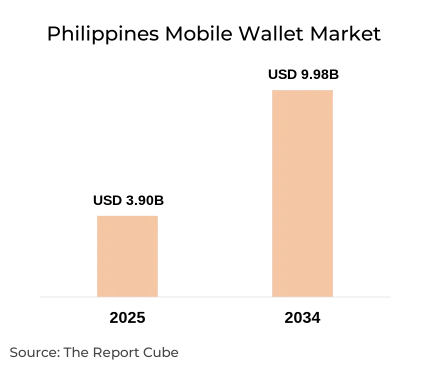
The Philippines Mobile Wallet Market is anticipated to register a CAGR of 11.0% during 2026-2034. The market size was valued at USD 3.9 billion in 2025 and is projected to reach USD 9.98 billion by 2034. The Philippines has become one of Southeast Asia’s most dynamic digital payments ecosystems as mobile wallets rapidly transform the country’s financial landscape. With more than 76 million internet users and smartphone penetration exceeding 73% in 2025, mobile wallet platforms have evolved into essential financial tools used daily for payments, transfers, and digital services.
Several structural factors are driving this rapid expansion. The Philippines has historically faced challenges with traditional banking accessibility, particularly in rural areas. Nearly 44% of Filipino adults remained unbanked in recent years, which created an opportunity for mobile wallets to fill the financial access gap. Platforms such as GCash and Maya have leveraged smartphone connectivity to offer services like micro-savings, microloans, remittances, and merchant payments without requiring traditional bank accounts. As a result, mobile wallets have become a primary entry point into the digital financial ecosystem for millions of Filipinos.
The expansion of e-commerce and the gig economy has also strengthened the demand for mobile wallets. Digital marketplaces such as Shopee and Lazada have integrated wallet-based payment systems to streamline purchases and reduce reliance on cash-on-delivery transactions. In 2025 alone, more than 65% of online purchases in the Philippines were completed using digital wallets, highlighting their growing role in retail commerce. At the same time, ride-hailing platforms and food delivery services have embedded wallet payments directly into their apps, creating a seamless digital transaction experience for users.
Government support and fintech investments continue to accelerate the market’s growth trajectory. The Bangko Sentral ng Pilipinas has actively encouraged electronic payment adoption through national financial inclusion strategies and open banking initiatives. These efforts have allowed fintech companies, banks, and technology providers to collaborate in building a robust digital payment infrastructure. As digital wallets become integrated with national ID systems, government services, and transport networks, their role is expanding far beyond simple payment tools, positioning them as a central pillar of the Philippines’ evolving digital economy.
Philippines Mobile Wallet Market Dynamics
Key Driver: Rapid Growth of Digital Payments and Financial Inclusion Initiatives
The primary force fueling the Philippines mobile wallet market is the country’s accelerating shift toward digital payments combined with strong financial inclusion programs. For many years, cash dominated retail transactions across the Philippines, with over 90% of payments historically conducted using physical currency. However, rapid digital transformation has reshaped consumer payment behavior. Mobile wallets now provide millions of Filipinos with access to financial services that were once limited to traditional banks.
One of the most influential factors driving adoption is the accessibility of mobile wallets for unbanked and underbanked populations. Opening a digital wallet requires only a smartphone and basic identity verification, removing many barriers associated with traditional banking. As of 2025, mobile wallet registrations in the Philippines exceeded 120 million accounts across various platforms, significantly outnumbering conventional bank accounts.
Remittances also play a critical role in market expansion. The Philippines receives over USD 36 billion annually in overseas remittances, and mobile wallets have become a convenient channel for sending and receiving these funds. Digital wallets enable users to instantly transfer money to family members, pay bills, or make purchases without visiting physical financial institutions. This convenience strengthens daily engagement with mobile wallet platforms.
In addition, government and private sector partnerships continue to integrate digital wallets into essential services such as transportation, utilities, and public benefit programs. These developments reinforce the role of mobile wallets as an everyday financial tool rather than just an alternative payment method.
Book your FREE 30-minute expert consultation today
Contact UsIndustry Trends: Super-App Ecosystems Transform Mobile Wallet Platforms
A major trend shaping the Philippines mobile wallet market is the emergence of “super-app” ecosystems where wallets serve as gateways to multiple financial and lifestyle services. Instead of functioning solely as payment platforms, leading mobile wallet providers are evolving into comprehensive digital ecosystems offering lending, insurance, investments, and e-commerce integration.
Platforms like GCash and Maya have expanded their services far beyond simple transfers and payments. Users can now open savings accounts, apply for personal loans, invest in mutual funds, purchase insurance policies, and even access cryptocurrency services directly through mobile wallet applications. These features transform digital wallets into full-service financial hubs.
The rise of QR-based payment infrastructure is another defining industry trend. QR code payments have gained widespread popularity among micro and small merchants due to their affordability and ease of deployment. Unlike traditional point-of-sale terminals, QR-based payment systems require minimal infrastructure, allowing small retailers and street vendors to accept digital payments quickly.
Another emerging trend is the integration of artificial intelligence and data analytics within wallet platforms. By analyzing transaction histories and spending patterns, mobile wallet providers can personalize financial recommendations, assess credit risk for microloans, and detect fraudulent activities. This intelligent financial management capability is improving user trust while creating new revenue opportunities for fintech companies.
Major Challenge: Cybersecurity Risks and Consumer Trust Concerns
While mobile wallet adoption continues to grow rapidly in the Philippines, cybersecurity risks remain one of the most pressing challenges facing the industry. Digital financial services inherently involve sensitive user data and financial transactions, making mobile wallet platforms attractive targets for cybercriminals.
Fraud schemes such as phishing attacks, identity theft, and unauthorized account access have become increasingly common as digital payment adoption rises. According to regional cybersecurity reports, Southeast Asia witnessed a 30% increase in digital financial fraud cases between 2023 and 2025. These incidents can undermine user confidence and slow adoption among new consumers who remain cautious about digital transactions.
Another challenge relates to digital literacy among certain population segments. While smartphone penetration continues to increase, not all users fully understand the security practices necessary to protect their accounts. Fraudsters often exploit this knowledge gap through social engineering tactics, tricking users into revealing passwords or verification codes.
Regulatory compliance and security infrastructure investments also place pressure on mobile wallet providers. Companies must continually upgrade encryption systems, fraud detection mechanisms, and customer authentication processes to maintain platform security. These requirements increase operational complexity and demand significant technological investment.
Addressing these challenges requires continuous collaboration between fintech companies, regulators, and cybersecurity experts to ensure the safety and reliability of digital financial systems.
Opportunity: Expansion of Mobile Wallet Services into Microfinance and Digital Banking
The Philippines mobile wallet market holds significant opportunities as wallet providers expand into microfinance and digital banking services. Many Filipinos still rely on informal lending channels due to limited access to traditional financial institutions. Mobile wallets have the potential to bridge this gap by offering accessible credit and savings products directly through smartphone applications.
Digital lending services embedded within wallet platforms allow users to apply for small loans instantly based on transaction history and behavioral data. This approach eliminates the lengthy documentation requirements typically associated with bank loans. As a result, millions of individuals and small business owners can gain access to credit for the first time.
Another major opportunity lies in supporting micro and small businesses. Mobile wallets enable small retailers to accept digital payments, track transactions, and manage finances more efficiently. This digitalization of small enterprises contributes to economic growth while expanding the transaction volume flowing through wallet platforms.
Cross-border payments represent an additional growth avenue. With millions of Filipinos working abroad, mobile wallets can simplify international remittance transfers through partnerships with global fintech providers. Faster and lower-cost remittance services strengthen user loyalty and increase transaction frequency.
As financial technology continues to evolve, mobile wallets are positioned to become central financial platforms that integrate payments, banking, lending, and digital commerce within a single ecosystem.
Philippines Mobile Wallet Market Segment-wise Analysis
By Payment Type:
- Remote Payments
- Proximity Payments
The remote payments segment holds the leading share in the Philippines mobile wallet market, accounting for nearly 61% of total transactions in 2025. This dominance reflects the country’s strong growth in online commerce and digital services. Remote payments allow users to complete transactions without physical proximity to merchants, making them ideal for e-commerce purchases, bill payments, and peer-to-peer transfers.
One of the key drivers behind remote payment growth is the rapid expansion of digital marketplaces. Platforms such as Shopee and Lazada have integrated mobile wallet payment options directly into their checkout systems, allowing consumers to complete purchases instantly. As online shopping continues to expand across the Philippines, remote wallet transactions are becoming the preferred payment method for millions of users.
Another factor supporting this segment’s growth is the widespread use of mobile wallets for bill payments and digital subscriptions. Consumers increasingly rely on wallet platforms to pay utility bills, telecom charges, streaming subscriptions, and government fees. These recurring transactions create consistent usage patterns and strengthen user engagement.
Furthermore, the rise of digital remittance transfers has reinforced the importance of remote payments. Overseas Filipino workers frequently use mobile wallets to send money to family members, making cross-location financial transfers faster and more convenient.
By Transaction Type:
- Peer-to-Peer Transfers
- Bill Payments
- Merchant Payments
- In-App Purchases
- Transport and Ticketing
- Others
The merchant payments segment represents the largest transaction category within the Philippines mobile wallet market, accounting for around 34% of total transactions. This growth reflects the increasing adoption of digital payments among retailers, restaurants, and service providers across urban and semi-urban areas.
Mobile wallets have significantly simplified payment acceptance for businesses of all sizes. Small merchants can now generate QR codes or integrate wallet payment gateways without purchasing expensive point-of-sale equipment. This accessibility has encouraged thousands of small businesses to accept digital payments, particularly in local markets and food establishments.
Large retail chains and shopping malls have also integrated mobile wallet payment systems into their checkout infrastructure. These integrations enable faster transactions, reduce reliance on cash handling, and provide digital transaction records for businesses.
The growing popularity of contactless payments further strengthens the merchant payment segment. Consumers increasingly prefer quick, touchless transactions when purchasing goods or services. Mobile wallets deliver this convenience through QR scanning or near-field communication technology.
As merchant acceptance continues to expand across the Philippines, digital wallet payments are becoming a standard option at both physical and online retail points.
Regional Projection of Philippines Mobile Wallet Industry
- Luzon
- Visayas
- Mindanao
Luzon represents the leading regional market within the Philippines mobile wallet ecosystem, accounting for approximately 56% of total digital wallet transactions. This dominance is primarily driven by the region’s strong economic activity, higher urbanization rates, and extensive digital infrastructure.
The National Capital Region, located in Luzon, serves as the country’s financial and commercial hub. Metro Manila hosts the headquarters of major banks, fintech companies, and technology providers, creating an environment that supports rapid digital payment adoption. Businesses across retail, transportation, hospitality, and e-commerce actively promote mobile wallet payments, reinforcing daily usage among consumers.
Another key factor contributing to Luzon’s leadership is its strong internet connectivity and smartphone penetration. Urban centers such as Quezon City, Makati, and Taguig have well-developed telecommunications networks, enabling smooth digital transaction experiences for wallet users.
Government digitalization programs are also heavily implemented in Luzon. Public transport systems, government services, and municipal payments increasingly support digital wallet transactions. These integrations encourage residents to rely on mobile wallets for everyday financial activities.
As digital infrastructure expands across Visayas and Mindanao, these regions are expected to experience accelerated growth in wallet adoption. However, Luzon will likely remain the largest market due to its economic scale and technology ecosystem.
Philippines Mobile Wallet Market Recent Developments
- 2025: Maya reported its first full year of profitability in 2025 with ₱1.7 billion net income, supported by strong deposit and lending growth along with partnerships with organizations including Cebuana Lhuillier, Philippine Airlines, Pepsi-Cola Products Philippines, and Ultra Mega Corporation to expand digital payments nationwide.
- 2025: PalawanPay partnered with online lending platform Digido to integrate digital credit services directly within the wallet application, enabling more than 20 million users to access quick digital loans and expanding financial inclusion among underserved consumers.
- 2025: PalawanPay also announced a strategic partnership with Rizal Commercial Banking Corporation during the Singapore FinTech Festival 2025, enabling users to open RCBC DiskarTech “PalaSave” accounts through PalawanPay’s microfinance network.
- 2025: GCash expanded its merchant QR payment ecosystem across thousands of small retailers and transport operators in Metro Manila and major provincial cities, accelerating adoption of contactless payments among everyday consumers.
- 2025: ShopeePay strengthened its integration within the Shopee marketplace by introducing loyalty rewards and installment payment features, encouraging repeat digital purchases and increasing wallet transaction frequency.
Need insights for a specific region within this market?
Request Regional DataWhy Choose This Report?
- Provides a comprehensive overview of the overall market analysis, encompassing key trends, consumer behavior analysis, and risk assessment to support strategic decision-making.
- Provides accurate, up-to-date insights into market size, segmentation, and emerging opportunities, helping to minimize risk & capitalizing on growth.
- Gives deep understanding of target audience preferences, investment habits, and communication channels for enhanced product development & marketing effectiveness.
- Delivers competitive analysis & benchmarking, uncovering the strengths & weaknesses of market competitors to guide strategies.
- Consolidate comprehensive market intelligence, reducing reasoning & streamlining research efforts.
- Facilitates customized market segmentation & risk mitigation strategies, fine-tuned to the business objectives.
- Aids in identifying both market challenges & untapped opportunities within the industry to drive long-term business growth.
- Provides valuable information based on actual customer data & search trends.
Table of Contents
- Introduction
- Objective of the Study
- Product and Category Definition
- Market Segmentation
- Study Variables
- Research Methodology
- Secondary Data Points
- Breakdown of Secondary Sources
- Primary Data Points
- Breakdown of Primary Interviews
- Secondary Data Points
- Executive Summary
- Market Dynamics
- Drivers
- Challenges
- Opportunity Assessment
- Recent Trends and Developments
- Regulatory and Policy Landscape
- Philippines Mobile Wallet Market Overview (2021-2034)
- Market Size, By Value (USD Billion)
- Market Share, By Payment Type
- Remote Payments
- Proximity Payments
- Market Share, By Transaction Type
- Peer-to-Peer Transfers
- Bill Payments
- Merchant Payments
- In-App Purchases
- Transport and Ticketing
- Others
- Market Share, By Technology
- QR Code-Based
- Near Field Communication (NFC)
- USSD-Based
- Others
- Market Share, By Operating System
- Android
- iOS
- Others
- Market Share, By Application
- Retail and E-commerce
- Financial Services
- Government and Utilities
- Telecom and Digital Services
- Transport and Mobility
- Others
- Market Share, By End User
- Individuals
- Micro and Small Businesses
- Medium and Large Enterprises
- Market Share, By Region
- Luzon
- Visayas
- Mindanao
- Market Share, By Company
- Revenue Shares and Analysis
- Competitive Landscape
- Luzon Mobile Wallet Market
- Market Size, By Value (USD Billion/Million)
- Market Share, By Payment Type
- Market Share, By Transaction Type
- Market Share, By Technology
- Market Share, By Operating System
- Market Share, By Application
- Market Share, By End User
- Visayas Mobile Wallet Market
- Market Size, By Value (USD Billion/Million)
- Market Share, By Payment Type
- Market Share, By Transaction Type
- Market Share, By Technology
- Market Share, By Operating System
- Market Share, By Application
- Market Share, By End User
- Mindanao Mobile Wallet Market
- Market Size, By Value (USD Billion/Million)
- Market Share, By Payment Type
- Market Share, By Transaction Type
- Market Share, By Technology
- Market Share, By Operating System
- Market Share, By Application
- Market Share, By End User
- Competitive Outlook and Company Profiles
- GCash
- Company Overview
- Product Portfolio
- Strategic Alliances/Partnerships
- Recent Developments
- Maya
- Company Overview
- Product Portfolio
- Strategic Alliances/Partnerships
- Recent Developments
- GrabPay
- Company Overview
- Product Portfolio
- Strategic Alliances/Partnerships
- Recent Developments
- ShopeePay
- Company Overview
- Product Portfolio
- Strategic Alliances/Partnerships
- Recent Developments
- Coins.ph
- Company Overview
- Product Portfolio
- Strategic Alliances/Partnerships
- Recent Developments
- Lazada Wallet
- Company Overview
- Product Portfolio
- Strategic Alliances/Partnerships
- Recent Developments
- StarPay
- Company Overview
- Product Portfolio
- Strategic Alliances/Partnerships
- Recent Developments
- OmniPay
- Company Overview
- Product Portfolio
- Strategic Alliances/Partnerships
- Recent Developments
- JuanCash
- Company Overview
- Product Portfolio
- Strategic Alliances/Partnerships
- Recent Developments
- AllEasy
- Company Overview
- Product Portfolio
- Strategic Alliances/Partnerships
- Recent Developments
- USSC Money
- Company Overview
- Product Portfolio
- Strategic Alliances/Partnerships
- Recent Developments
- Cebuana Quikz
- Company Overview
- Product Portfolio
- Strategic Alliances/Partnerships
- Recent Developments
- M Lhuillier (ML Wallet)
- Company Overview
- Product Portfolio
- Strategic Alliances/Partnerships
- Recent Developments
- Bayad (App)
- Company Overview
- Product Portfolio
- Strategic Alliances/Partnerships
- Recent Developments
- GoTyme Bank
- Company Overview
- Product Portfolio
- Strategic Alliances/Partnerships
- Recent Developments
- SeaBank
- Company Overview
- Product Portfolio
- Strategic Alliances/Partnerships
- Recent Developments
- PalawanPay
- Company Overview
- Product Portfolio
- Strategic Alliances/Partnerships
- Recent Developments
- Others
- GCash
- Contact Us and Disclaimer
Top Key Players & Market Share Outlook
- GCash
- Maya
- GrabPay
- ShopeePay
- Coins.ph
- Lazada Wallet
- StarPay
- OmniPay
- JuanCash
- AllEasy
- USSC Money
- Cebuana Quikz
- M Lhuillier (ML Wallet)
- Bayad (App)
- GoTyme Bank
- SeaBank
- PalawanPay
Frequently Asked Questions






