



Build Your Custom Market Intelligence Report
Customize Your ReportUnited States Nitrogenous Fertilizer Market Insights & Analysis
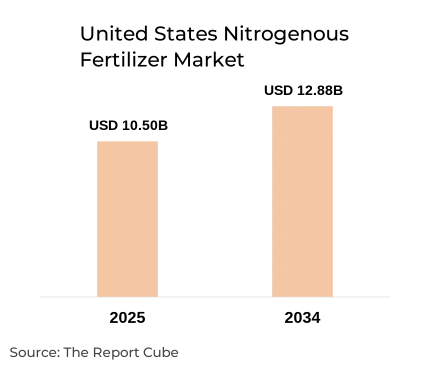
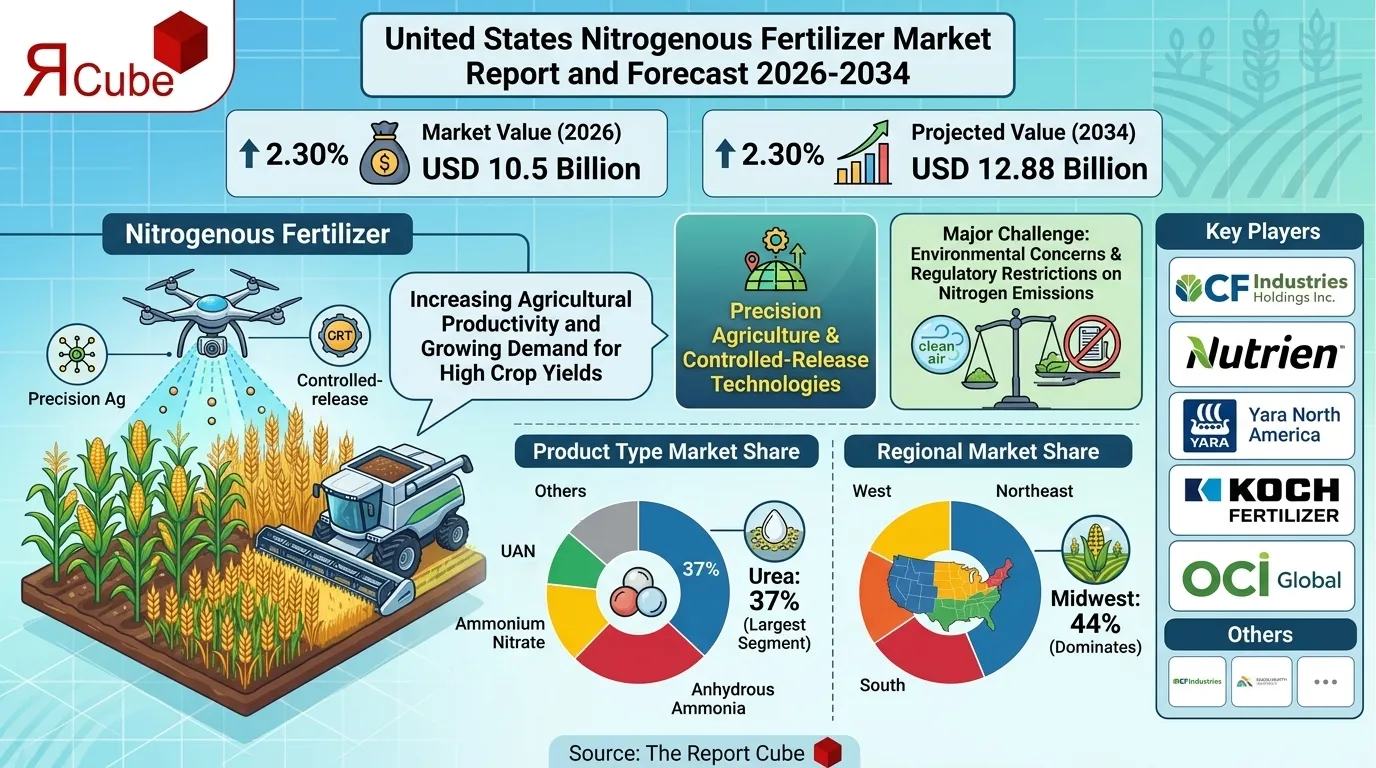
The United States Nitrogenous Fertilizer Market Market is anticipated to register a 2.30% during 2026-2034. The market size was valued at USD 10.5 Billion and is projected to reach USD 12.88 Billion by 2034.
The United States Nitrogenous Fertilizer Market plays a critical role in supporting the country’s agricultural productivity and food security. Nitrogenous fertilizers are widely used to enhance soil fertility and improve crop yield by supplying essential nitrogen nutrients required for plant growth. In the United States, the agricultural sector heavily depends on nitrogen fertilizers for large-scale crop production, particularly for cereals and grains such as corn, wheat, and rice. The increasing demand for high agricultural output to meet both domestic consumption and export requirements continues to drive the use of nitrogen-based fertilizers across the country. Modern farming practices rely on advanced fertilizer formulations to optimize nutrient efficiency and maintain soil productivity while reducing nutrient loss.
Additionally, technological advancements in fertilizer production and precision agriculture are transforming the nitrogen fertilizer industry. Farmers are increasingly adopting precision nutrient management techniques that optimize fertilizer application based on soil health data and crop requirements. These technologies help improve fertilizer efficiency and reduce environmental impact associated with excessive nitrogen application. Moreover, the expansion of commercial agriculture and the growing demand for high-quality agricultural produce are further strengthening fertilizer consumption. Fertilizer manufacturers are also investing in innovative nitrogen products that improve nutrient absorption and reduce volatilization losses, contributing to sustainable farming practices across the United States.
United States Nitrogenous Fertilizer Market Recent Developments
- 2025: CF Industries expanded ammonia production capacity in the United States to support increasing agricultural fertilizer demand.
- 2025: Nutrien introduced enhanced nitrogen fertilizer formulations designed to improve nutrient efficiency and crop productivity.
Government Initiatives & Policies
- USDA Climate-Smart Agriculture Initiative: Encourages sustainable farming practices and efficient fertilizer management.
- USDA Fertilizer Production Expansion Program: Supports domestic fertilizer production and strengthens agricultural supply chains.
United States Nitrogenous Fertilizer Market Dynamics
Key Driver: Increasing Agricultural Productivity and Growing Demand for High Crop Yields
The rising demand for agricultural productivity is a major driver supporting the United States Nitrogenous Fertilizer Market. Farmers across the country are under constant pressure to maximize crop yields while maintaining soil health and sustainable farming practices. Nitrogen fertilizers play a vital role in enhancing plant growth by improving chlorophyll formation and accelerating photosynthesis processes. As a result, nitrogen fertilizers significantly increase crop yield and overall agricultural output. Large-scale cultivation of staple crops such as corn, wheat, soybeans, and rice requires substantial nitrogen supplementation to maintain soil fertility and support optimal plant development.
Additionally, the United States is one of the world’s largest agricultural exporters, supplying significant quantities of grains, oilseeds, and agricultural commodities to global markets. To maintain consistent crop production levels and meet export demands, farmers rely heavily on nitrogen-based fertilizers. Modern agricultural practices including high-yield crop varieties and mechanized farming systems further increase the need for nutrient-rich soil conditions. The adoption of precision farming technologies has also enabled farmers to apply fertilizers more efficiently, optimizing nutrient delivery while minimizing waste. These developments collectively contribute to the sustained demand for nitrogenous fertilizers in the United States.
Industry Trends: Integration of Precision Agriculture and Controlled-Release Fertilizer Technologies
The United States Nitrogenous Fertilizer Market is witnessing significant technological transformation through the adoption of precision agriculture and controlled-release fertilizer technologies. Precision agriculture uses advanced data analytics, satellite imaging, and soil monitoring systems to determine optimal fertilizer application rates for specific crop conditions. These technologies allow farmers to precisely manage nutrient inputs based on soil composition, weather patterns, and crop growth stages. As a result, fertilizer usage becomes more efficient while minimizing environmental impact.
Book your FREE 30-minute expert consultation today
Contact UsAnother emerging trend in the market is the development of controlled-release nitrogen fertilizers that gradually release nutrients over time. These fertilizers improve nutrient uptake by plants and reduce nitrogen losses caused by leaching and volatilization. Controlled-release formulations are particularly beneficial for high-value crops and intensive farming operations where nutrient management plays a crucial role in maximizing productivity. Additionally, fertilizer manufacturers are investing in environmentally friendly nitrogen products designed to support sustainable agriculture initiatives. The growing emphasis on reducing greenhouse gas emissions and improving soil health is encouraging the development of innovative fertilizer technologies that align with environmental sustainability goals.
Major Challenge: Environmental Concerns and Regulatory Restrictions on Nitrogen Emissions
Despite steady market demand, the United States Nitrogenous Fertilizer Market faces several challenges related to environmental concerns and regulatory restrictions. Excessive nitrogen fertilizer application can lead to environmental issues such as water contamination, soil degradation, and greenhouse gas emissions. Nitrogen runoff from agricultural fields may enter rivers, lakes, and groundwater systems, contributing to nutrient pollution and ecosystem imbalance. These environmental concerns have prompted regulatory agencies to introduce stricter guidelines governing fertilizer application practices.
Government regulations aimed at reducing nitrogen emissions and improving environmental sustainability may impose limitations on fertilizer usage in certain regions. Farmers must comply with nutrient management regulations that encourage responsible fertilizer application and soil conservation practices. Additionally, fluctuations in natural gas prices, which serve as a key raw material for nitrogen fertilizer production, can influence production costs and market pricing. These factors may create economic challenges for fertilizer manufacturers and agricultural producers.
Opportunity: Expansion of Sustainable Agriculture and Development of Eco-Friendly Fertilizer Products
The growing emphasis on sustainable agriculture presents significant opportunities for the United States Nitrogenous Fertilizer Market. Agricultural stakeholders are increasingly focusing on environmentally responsible farming practices that improve soil health and reduce environmental impact. Fertilizer manufacturers are responding by developing eco-friendly nitrogen products designed to improve nutrient efficiency and minimize environmental pollution. Enhanced efficiency fertilizers, which include inhibitors and controlled-release technologies, are gaining popularity among farmers seeking sustainable nutrient management solutions.
Additionally, government programs supporting climate-smart agriculture and soil conservation initiatives are encouraging the adoption of advanced fertilizer technologies. These programs promote balanced nutrient management and encourage farmers to adopt sustainable fertilization practices. The expansion of organic farming and specialty crop cultivation also creates opportunities for customized fertilizer solutions tailored to specific agricultural requirements. As the agricultural sector continues to evolve toward sustainability, nitrogen fertilizer manufacturers are expected to play a key role in developing innovative nutrient management solutions that support both productivity and environmental protection.
United States Nitrogenous Fertilizer Market Segment-wise Analysis
By Product Type:
- Urea
- Ammonium Nitrate
- Ammonium Sulfate
- Calcium Ammonium Nitrate (CAN)
Urea represents the largest segment in the United States Nitrogenous Fertilizer Market, accounting for approximately 37% of total market share. Urea is widely used in agriculture due to its high nitrogen content and cost-effective nutrient delivery. Farmers prefer urea-based fertilizers because they provide efficient nitrogen supply to crops and support strong plant growth. Urea fertilizers are particularly popular in large-scale farming operations where high nutrient efficiency is required to maintain soil fertility across extensive agricultural fields.
Ammonium nitrate and ammonium sulfate also represent significant segments within the nitrogen fertilizer market. Ammonium nitrate fertilizers provide rapid nitrogen availability and are widely used for crop cultivation requiring quick nutrient absorption. Meanwhile, ammonium sulfate fertilizers are commonly applied in soils requiring both nitrogen and sulfur supplementation. Calcium ammonium nitrate (CAN) fertilizers are gaining popularity due to their balanced nutrient composition and reduced volatilization losses. These fertilizers improve nutrient absorption while minimizing environmental impact. As agricultural practices continue to evolve, farmers are increasingly selecting fertilizer products based on soil conditions, crop requirements, and nutrient efficiency.
By Crop Type:
- Cereals & Grains
- Fruits & Vegetables
- Oilseeds & Pulses
- Turf & Ornamentals
Cereals and grains dominate the United States Nitrogenous Fertilizer Market, accounting for nearly 49% of total fertilizer consumption. Crops such as corn, wheat, and rice require substantial nitrogen inputs to achieve optimal yield levels and maintain soil productivity. The United States is one of the largest producers of corn globally, and nitrogen fertilizers play a critical role in supporting corn cultivation. High nitrogen demand for cereals and grains significantly contributes to overall fertilizer consumption within the agricultural sector.
Fruits and vegetables also represent an important segment due to increasing consumer demand for fresh produce and high-value horticultural crops. Nitrogen fertilizers support plant growth, leaf development, and crop productivity across various horticultural farming systems. Oilseeds and pulses, including soybeans and peanuts, also require balanced nitrogen supplementation during specific growth stages. Meanwhile, turf and ornamental plants used in landscaping, golf courses, and recreational facilities contribute to additional fertilizer demand. The diversification of agricultural production across multiple crop categories continues to support steady fertilizer consumption across the United States.
Need insights for a specific region within this market?
Request Regional DataRegional Projection of United States Nitrogenous Fertilizer Industry
- Midwest United States
- South United States
- West United States
- Northeast United States
The Midwest United States dominates the United States Nitrogenous Fertilizer Market with an estimated market share of approximately 44%. The region is widely recognized as the country’s primary agricultural hub, often referred to as the “Corn Belt.” States such as Iowa, Illinois, Nebraska, and Minnesota produce significant volumes of corn, soybeans, and other staple crops that require substantial nitrogen fertilizer application. The presence of large-scale commercial farms and advanced agricultural infrastructure further strengthens fertilizer demand in the region.
The South United States also represents an important agricultural region due to extensive cultivation of crops such as cotton, rice, peanuts, and vegetables. Fertilizer demand in the region is supported by diverse crop production systems and favorable climatic conditions for agriculture. Meanwhile, the West United States contributes to fertilizer consumption through horticultural farming and specialty crop cultivation including fruits, nuts, and vegetables. The Northeast United States maintains moderate fertilizer demand primarily driven by smaller-scale farming operations and commercial landscaping activities. As agricultural production continues to expand across these regions, the demand for nitrogen fertilizers is expected to remain stable throughout the forecast period.
Why Choose This Report?
- Provides a comprehensive overview of the overall market analysis, encompassing key trends, consumer behavior analysis, and risk assessment to support strategic decision-making.
- Provides accurate, up-to-date insights into market size, segmentation, and emerging opportunities, helping to minimize risk & capitalizing on growth.
- Gives deep understanding of target audience preferences, investment habits, and communication channels for enhanced product development & marketing effectiveness.
- Delivers competitive analysis & benchmarking, uncovering the strengths & weaknesses of market competitors to guide strategies.
- Consolidate comprehensive market intelligence, reducing reasoning & streamlining research efforts.
- Facilitates customized market segmentation & risk mitigation strategies, fine-tuned to the business objectives.
- Aids in identifying both market challenges & untapped opportunities within the industry to drive long-term business growth.
- Provides valuable information based on actual customer data & search trends.
Table of Contents
- Introduction
- Objective of the Study
- Nitrogenous Fertilizer Market Definition
- Market Segmentation
- Study Variables
- Research Methodology
- Secondary Data Points
- Breakdown of Secondary Sources
- Primary Data Points
- Breakdown of Primary Interviews
- Secondary Data Points
- Executive Summary
- Market Dynamics
- Drivers
- Challenges
- Opportunity Assessment
- Recent Trends and Developments
- Regulatory and Policy Landscape
- United States Nitrogenous Fertilizer Market Overview (2026–2034)
- Market Size, By Value (USD Billion)
- Market Share, By Product Type
- Urea
- Ammonium Nitrate
- Ammonium Sulfate
- Calcium Ammonium Nitrate (CAN)
- Anhydrous Ammonia
- Other Nitrogenous Fertilizers
- Market Share, By Form
- Solid
- Liquid
- Market Share, By Crop Type
- Cereals & Grains
- Fruits & Vegetables
- Oilseeds & Pulses
- Turf & Ornamentals
- Other Crops
- Market Share, By Application Method
- Broadcasting
- Fertigation
- Foliar Application
- Soil Injection
- Market Share, By End User
- Agricultural Farms
- Commercial Landscaping
- Golf Courses & Turf Management
- Market Share, By Company
- Competition Characteristics
- Revenue Shares & Analysis
- Market Share, By Region
- Midwest United States Nitrogenous Fertilizer Market
- Market Size, By Value
- Market Share, By Product Type
- Market Share, By Crop Type
- South United States Nitrogenous Fertilizer Market
- Market Size, By Value
- Market Share, By Product Type
- Market Share, By Crop Type
- West United States Nitrogenous Fertilizer Market
- Market Size, By Value
- Market Share, By Product Type
- Market Share, By Crop Type
- Northeast United States Nitrogenous Fertilizer Market
- Market Size, By Value
- Market Share, By Product Type
- Market Share, By Crop Type
- Midwest United States Nitrogenous Fertilizer Market
- Competitive Outlook and Company Profiles
- CF Industries Holdings Inc.
- Company Overview
- Nitrogen Fertilizer Portfolio
- Strategic Alliances/Partnerships
- Recent Developments
- Nutrien Ltd.
- Company Overview
- Fertilizer Product Portfolio
- Strategic Alliances/Partnerships
- Recent Developments
- Yara North America
- Company Overview
- Nitrogen Fertilizer Portfolio
- Strategic Alliances/Partnerships
- Recent Developments
- Koch Fertilizer
- Company Overview
- Nitrogen Fertilizer Portfolio
- Strategic Alliances/Partnerships
- Recent Developments
- OCI Global
- Company Overview
- Nitrogen Fertilizer Portfolio
- Strategic Alliances/Partnerships
- Recent Developments
- Others
- Company Overview
- Business Segments
- Strategic Alliances/Partnerships
- Recent Developments
- CF Industries Holdings Inc.
- Contact Us / Disclaimer
Top Key Players & Market Share Outlook
- CF Industries Holdings Inc.
- Nutrien Ltd.
- Yara North America
- Koch Fertilizer
- OCI Global
- Others
Frequently Asked Questions






