




Build Your Custom Market Intelligence Report
Customize Your ReportBrazil Oil and Gas Market Insights & Analysis
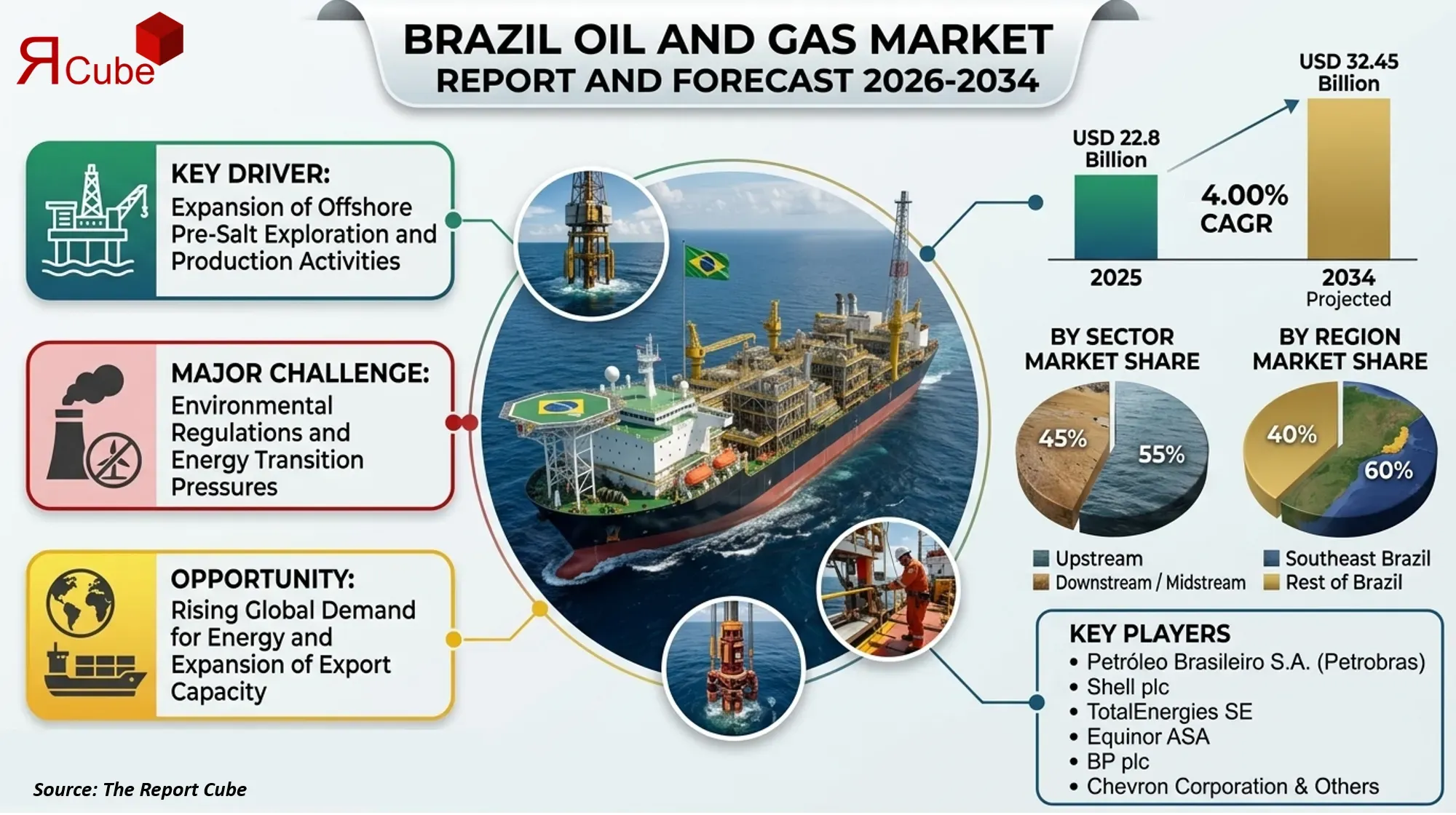
The Brazil Oil and Gas Market is anticipated to register a 4.00% during 2026-2034. The market size was valued at USD 22.8 Billion in 2025 and is projected to reach USD 32.45 Billion by 2034. Brazil remains one of the most influential oil and gas markets in Latin America due to its extensive offshore reserves, particularly in the pre-salt basins located in the Atlantic Ocean. Over the past decade, the country has strengthened its position as a major global energy supplier, driven by expanding exploration activities and continuous investments in deepwater and ultra-deepwater oil fields.
The discovery and development of pre-salt reserves have significantly transformed Brazil’s hydrocarbon production capacity. Offshore fields in regions such as the Santos and Campos basins have contributed substantially to the country’s crude oil output. Technological advancements in subsea production systems, drilling technologies, and floating production storage and offloading (FPSO) units have enabled energy companies to access deeper reservoirs efficiently. As a result, Brazil’s crude oil production has continued to grow steadily, reinforcing its role as a strategic supplier in global energy markets.
Furthermore, rising energy demand across industrial sectors, transportation, and power generation is contributing to the growth of the Brazil Oil and Gas Market. Government-led initiatives aimed at attracting foreign investment and improving regulatory frameworks have further encouraged global energy companies to participate in exploration and production activities. With increasing investments in offshore infrastructure, pipeline networks, and refining capacities, Brazil’s oil and gas industry is expected to experience stable expansion through 2034.
Brazil Oil and Gas Market Recent Developments
- 2025: Petrobras expanded production capacity in the Búzios offshore field, strengthening Brazil’s deepwater oil output.
- 2025: Shell Brazil advanced new offshore drilling campaigns in the Santos Basin to enhance crude oil production capacity.
Government Initiatives & Policies
- Brazil National Energy Policy (CNPE): Strategy encouraging investments in offshore oil exploration and production development.
- Petroleum Law (Law No. 9,478/1997): Regulatory framework governing oil exploration, production, and licensing in Brazil.
Brazil Oil and Gas Market Dynamics
Key Driver: Expansion of Offshore Pre-Salt Exploration and Production Activities
The rapid expansion of offshore exploration activities in Brazil’s pre-salt basins remains the most significant driver for the Brazil Oil and Gas Market. The discovery of massive hydrocarbon reserves beneath thick salt layers in offshore regions has positioned Brazil among the leading global oil producers. Pre-salt fields such as Búzios, Lula, and Mero have demonstrated exceptionally high production potential, attracting substantial investments from both domestic and international oil companies.
Technological innovation in deepwater drilling and subsea infrastructure has enabled companies to extract hydrocarbons from reservoirs located more than 2,000 meters below sea level. Floating production storage and offloading units (FPSOs) play a crucial role in Brazil’s offshore production model, allowing efficient extraction, processing, and storage of crude oil directly at sea. These technologies have improved operational efficiency and reduced production costs in deepwater environments.
Additionally, Brazil’s regulatory reforms and licensing rounds have encouraged foreign energy companies to participate in exploration projects. Partnerships between Petrobras and international firms such as Shell, TotalEnergies, and Equinor have significantly strengthened exploration capabilities. With continued investments in offshore development projects, Brazil is expected to maintain strong production growth and expand its oil export capacity during the forecast period.
Book your FREE 30-minute expert consultation today
Contact UsIndustry Trends: Increasing Investments in Deepwater Infrastructure and LNG Development
The Brazil Oil and Gas Market is witnessing a growing trend of investments in offshore infrastructure and natural gas development projects. As production from pre-salt reserves expands, companies are focusing on strengthening midstream infrastructure including subsea pipelines, transportation networks, and storage facilities. These investments are critical for ensuring the efficient transportation of crude oil and natural gas from offshore fields to onshore processing facilities.
Another significant trend shaping the industry is the increasing development of natural gas and liquefied natural gas (LNG) infrastructure. Brazil has been investing heavily in LNG terminals and gas pipeline networks to diversify its energy supply and reduce reliance on imported fuels. Natural gas is gaining importance as a transitional energy source due to its relatively lower carbon emissions compared with coal and oil.
Additionally, digital technologies such as predictive maintenance systems, remote monitoring platforms, and advanced data analytics are being adopted across offshore operations. These technologies help energy companies optimize production performance, improve safety standards, and reduce operational downtime. The integration of digital solutions across exploration and production activities is expected to enhance efficiency and strengthen the competitiveness of Brazil’s oil and gas sector.
Major Challenge: Environmental Regulations and Energy Transition Pressures
Environmental regulations and global energy transition pressures present significant challenges for the Brazil Oil and Gas Market. Governments, investors, and environmental organizations worldwide are increasingly advocating for reduced dependence on fossil fuels and greater adoption of renewable energy sources. This shift toward cleaner energy technologies has created uncertainty regarding long-term investments in hydrocarbon exploration and production.
Brazil’s offshore drilling activities also face strict environmental compliance requirements aimed at protecting marine ecosystems. Oil companies operating in offshore regions must adhere to rigorous environmental impact assessments, safety regulations, and spill prevention measures. These regulatory requirements can increase operational costs and extend project approval timelines.
Another challenge relates to fluctuations in global crude oil prices, which can significantly impact investment decisions within the industry. Oil price volatility affects exploration budgets, production planning, and profitability for energy companies operating in Brazil. Despite these challenges, technological improvements and strategic partnerships continue to support long-term growth in the sector.
Opportunity: Rising Global Demand for Energy and Expansion of Export Capacity
The increasing global demand for energy presents significant opportunities for the Brazil Oil and Gas Market. As many countries continue to depend on hydrocarbons for transportation, industrial production, and electricity generation, Brazil’s expanding oil production capacity places it in a strong position to meet international demand. Brazil has already emerged as a major crude oil exporter, supplying markets across Asia, Europe, and North America.
Investments in refining infrastructure and export terminals are expected to further strengthen Brazil’s energy trade capabilities. The modernization of refineries and development of new processing facilities will allow the country to increase its production of refined petroleum products such as diesel, gasoline, and petrochemicals. This expansion could enhance Brazil’s competitiveness in global energy markets.
Moreover, the development of natural gas infrastructure and LNG projects provides opportunities for diversifying the country’s energy portfolio. By expanding domestic gas production and improving pipeline connectivity, Brazil can strengthen energy security while supporting industrial growth. These strategic developments are likely to create long-term growth opportunities for the Brazil Oil and Gas Industry.
Brazil Oil and Gas Market Segment-wise Analysis
By Sector:
- Upstream
- Midstream
- Downstream
- Others
The upstream sector dominates the Brazil Oil and Gas Market, accounting for nearly 55% of the total market share. Exploration and production activities represent the core of Brazil’s hydrocarbon industry due to the country’s extensive offshore reserves. Major international oil companies continue to invest heavily in exploration projects, particularly in deepwater and ultra-deepwater fields. Midstream operations, including transportation and storage infrastructure, play a critical role in connecting offshore production sites with onshore processing facilities. These networks ensure the efficient movement of crude oil and natural gas across the country’s energy supply chain. Meanwhile, the downstream sector focuses on refining, distribution, and retail marketing of petroleum products. Growing domestic fuel demand from transportation and industrial sectors is driving investments in refinery modernization and distribution infrastructure.
Access Key Market Segment Analysis?
Download SampleBy Resource Type:
- Crude Oil
- Natural Gas
- Liquefied Natural Gas (LNG)
- Others
Crude oil holds the largest share in the Brazil Oil and Gas Market, accounting for approximately 65% of total market revenue. Brazil’s offshore oil reserves in the pre-salt basins represent one of the most productive deepwater resources globally. These reserves contribute significantly to the country’s export revenues and energy production capacity. Natural gas is also gaining increasing importance as the government seeks to diversify its energy mix and reduce dependence on imported fuels. The development of LNG terminals and gas distribution networks is expanding the role of natural gas within Brazil’s energy infrastructure. LNG imports and domestic production help stabilize the country’s gas supply and support industrial energy consumption. As Brazil continues to develop its offshore resources and strengthen gas infrastructure, the natural gas segment is expected to experience steady growth in the coming years.
Regional Projection of Brazil Oil and Gas Industry
- Southeast Brazil
- South Brazil
- North Brazil
- Northeast Brazil
Southeast Brazil leads the Brazil Oil and Gas Market, holding nearly 60% of the total market share. The region hosts some of the country’s most significant offshore oil fields, including the Santos and Campos basins. These basins contain vast pre-salt reserves that contribute substantially to Brazil’s crude oil production. Major offshore drilling operations and floating production units are concentrated in this region, making it the primary hub for exploration and production activities.
In addition to offshore production, Southeast Brazil also hosts major refining and petrochemical facilities that process crude oil into refined petroleum products. Industrial centers such as Rio de Janeiro and São Paulo play a vital role in energy distribution and export operations. The region’s advanced infrastructure, including pipelines, ports, and refineries, supports efficient energy transportation and processing.
Other regions such as South Brazil and Northeast Brazil are gradually expanding their role in the industry through new exploration activities and infrastructure development projects. Meanwhile, North Brazil holds potential for future onshore exploration initiatives. With ongoing investments in offshore production capacity and energy infrastructure, Southeast Brazil is expected to remain the dominant regional contributor to the Brazil Oil and Gas Market throughout the forecast period.
Need insights for a specific region within this market?
Request Regional DataWhy Choose This Report?
- Provides a comprehensive overview of the overall market analysis, encompassing key trends, consumer behavior analysis, and risk assessment to support strategic decision-making.
- Provides accurate, up-to-date insights into market size, segmentation, and emerging opportunities, helping to minimize risk & capitalizing on growth.
- Gives deep understanding of target audience preferences, investment habits, and communication channels for enhanced product development & marketing effectiveness.
- Delivers competitive analysis & benchmarking, uncovering the strengths & weaknesses of market competitors to guide strategies.
- Consolidate comprehensive market intelligence, reducing reasoning & streamlining research efforts.
- Facilitates customized market segmentation & risk mitigation strategies, fine-tuned to the business objectives.
- Aids in identifying both market challenges & untapped opportunities within the industry to drive long-term business growth.
- Provides valuable information based on actual customer data & search trends.
Table of Contents
- Introduction
- Objective of the Study
- Product and Category Definition
- Market Segmentation
- Study Variables
- Research Methodology
- Secondary Data Points
- Breakdown of Secondary Sources
- Primary Data Points
- Breakdown of Primary Interviews
- Secondary Data Points
- Executive Summary
- Market Dynamics
- Drivers
- Challenges
- Opportunity Assessment
- Recent Trends and Developments
- Regulatory and Policy Landscape
- Brazil Oil and Gas Market Overview (2026-2034)
- Market Size, By Value (USD Billion)
- Market Share, By Sector
- Upstream
- Exploration
- Production
- Midstream
- Transportation
- Storage
- Downstream
- Refining
- Distribution
- Retail Marketing
- Upstream
- Market Share, By Resource Type
- Crude Oil
- Natural Gas
- Liquefied Natural Gas (LNG)
- Market Share, By Location of Deployment
- Onshore
- Offshore
- Market Share, By End Use
- Power Generation
- Transportation
- Industrial Use
- Residential and Commercial
- Market Share, By Region
- Southeast Brazil
- South Brazil
- North Brazil
- Northeast Brazil
- Central-West Brazil
- Market Share, By Company
- Revenue Shares and Analysis
- Competitive Landscape
- Southeast Brazil Oil and Gas Market
- Market Size, By Value (USD Billion/Million)
- Market Share, By Sector
- Market Share, By Resource Type
- Market Share, By Location of Deployment
- Market Share, By End Use
- South Brazil Oil and Gas Market
- Market Size, By Value (USD Billion/Million)
- Market Share, By Sector
- Market Share, By Resource Type
- Market Share, By Location of Deployment
- Market Share, By End Use
- North Brazil Oil and Gas Market
- Market Size, By Value (USD Billion/Million)
- Market Share, By Sector
- Market Share, By Resource Type
- Market Share, By Location of Deployment
- Market Share, By End Use
- Northeast Brazil Oil and Gas Market
- Market Size, By Value (USD Billion/Million)
- Market Share, By Sector
- Market Share, By Resource Type
- Market Share, By Location of Deployment
- Market Share, By End Use
- Central-West Brazil Oil and Gas Market
- Market Size, By Value (USD Billion/Million)
- Market Share, By Sector
- Market Share, By Resource Type
- Market Share, By Location of Deployment
- Market Share, By End Use
- Competitive Outlook and Company Profiles
- Petróleo Brasileiro S.A. (Petrobras)
- Company Overview
- Product Portfolio
- Strategic Alliances/Partnerships
- Recent Developments
- Shell Brazil
- Company Overview
- Product Portfolio
- Strategic Alliances/Partnerships
- Recent Developments
- TotalEnergies SE
- Company Overview
- Product Portfolio
- Strategic Alliances/Partnerships
- Recent Developments
- Equinor ASA
- Company Overview
- Product Portfolio
- Strategic Alliances/Partnerships
- Recent Developments
- BP plc
- Company Overview
- Product Portfolio
- Strategic Alliances/Partnerships
- Recent Developments
- Chevron Corporation
- Company Overview
- Product Portfolio
- Strategic Alliances/Partnerships
- Recent Developments
- Petróleo Brasileiro S.A. (Petrobras)
- Contact Us and Disclaimer
Top Key Players & Market Share Outlook
-
Petróleo Brasileiro S.A. (Petrobras)
-
Shell plc
-
TotalEnergies SE
-
Equinor ASA
-
BP plc
-
Chevron Corporation & Others
Frequently Asked Questions






